Detecting Onion Storage Hot Spots: Temperature, Humidity, VOCs and Inspection

Expert perspective: Alexander Samsonov, Agricultural Storage Engineer. Read the original LinkedIn perspective.
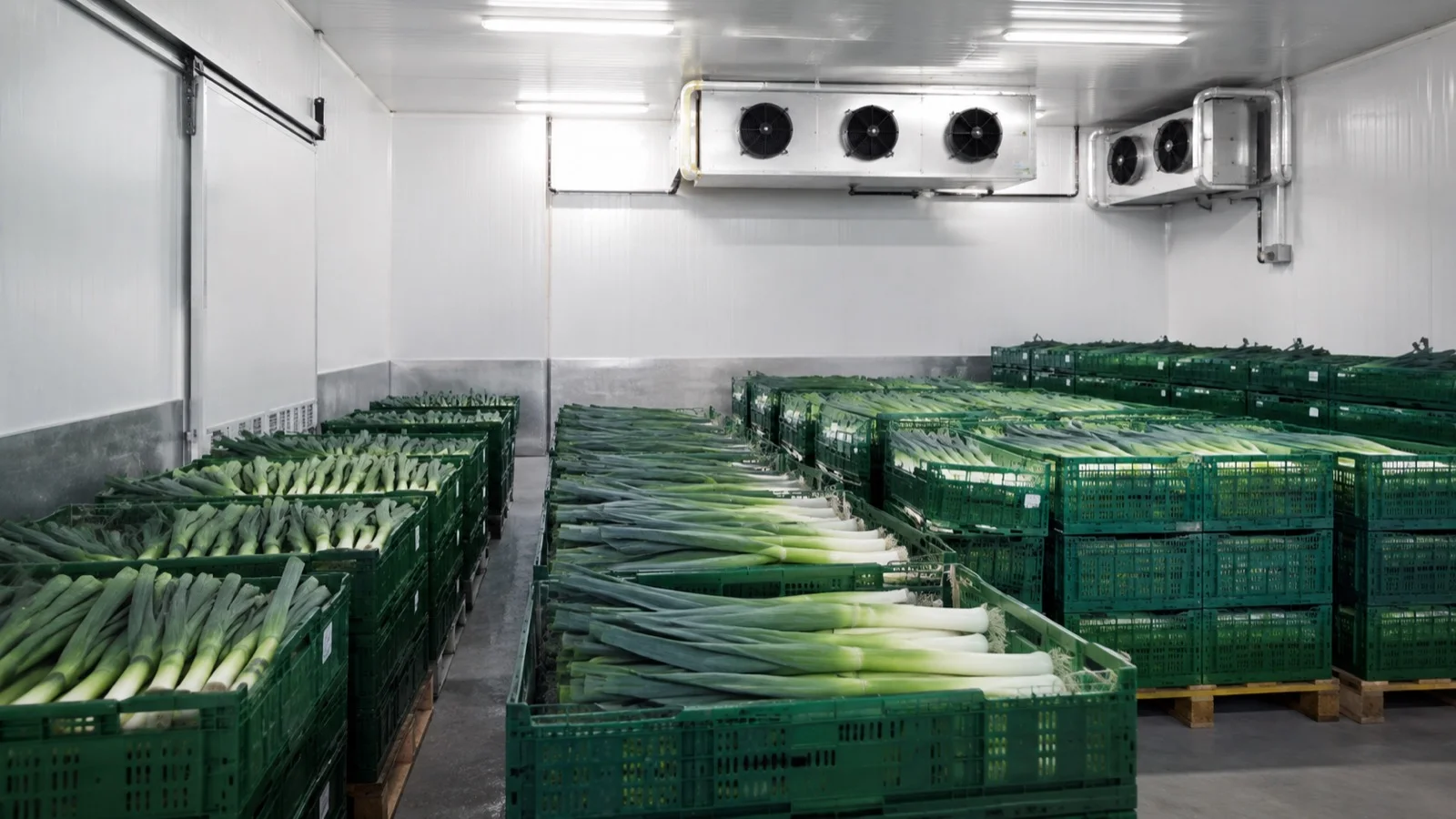
An onion lot can begin deteriorating in a local zone while the chamber average still looks normal. The objective is not to wait for one gas alarm; it is to combine crop temperature, humidity, airflow, odour and inspection into an early-warning process.
A LinkedIn discussion by Alexander Samsonov focused on ammonia. Research supports a broader approach: infected onions can change the headspace mixture of volatile organic compounds, while temperature and relative-humidity patterns also provide useful quality signals.

Why Local Hot Spots Form
- Wet or insufficiently cured bulbs enter one part of the load.
- Mechanical damage or soil creates a concentrated infection risk.
- An air short circuit leaves another zone with insufficient movement.
- Condensation develops near a cold surface or after a temperature change.
- Mixed varieties, sizes or maturity levels respond differently to one regime.
Temperature Is a Trend, Not a Magic Threshold
Respiring and deteriorating product releases heat and moisture. A sensor that drifts upward relative to neighbouring points may identify a zone that needs investigation. The useful signal is the spatial and temporal difference—not a claim that any tiny change proves decay.
Sensor accuracy, resolution, calibration and placement must be distinguished. A display with many decimal places does not guarantee that the measurement is accurate enough to diagnose a biological event.
Humidity Explains the Moisture Environment
Research in commercial onion storage has evaluated temperature and RH near the bulbs as markers of quality change. Persistent RH variation, condensation risk and delayed drying deserve attention, especially when paired with a temperature anomaly or visible deterioration.
What Gas and VOC Sensors Can Add
Healthy onions naturally emit a complex mixture of sulfur compounds and other volatiles. Infection changes this mixture. Experimental studies using FAIMS and gas-sensor arrays have distinguished storage infections in potatoes and onions, demonstrating the potential for non-destructive alerts.
Ammonia may be one signal in a multi-gas system, but it should not be treated as a universal standalone diagnosis. Sensor cross-sensitivity, humidity, background onion volatiles and the specific pathogen all affect the reading. Gas sensing should trigger verification, not an automatic conclusion.
A Practical Response Sequence
- Compare the suspect temperature and RH sensor with neighbouring points.
- Check calibration, wiring and whether the sensor is actually in contact with the representative air zone.
- Inspect airflow, damper position, duct blockage and the product surface.
- Take representative bulbs from the suspect zone using safe access procedures.
- Identify moisture, softness, odour, visible mold and the depth of damage.
- Decide whether to isolate, sort, unload early or adjust the operating plan with a crop specialist.
Do Not “Dry the Rot” Blindly
Targeted airflow can support drying when the problem is excess surface moisture and the air has useful drying capacity. It cannot restore decomposed tissue, and excessive local ventilation may spread spores, over-dry sound bulbs or move heat and moisture elsewhere. Any intervention should be based on the diagnosed cause and measured air conditions.
The strongest early-warning system is layered: representative sensors + spatial trends + airflow verification + regular human inspection.
Related reading: black mold in onion storage, onion storage in hot and humid climates and Agrovent's gas-removal engineering. Discuss an onion storage monitoring project with Agrovent India.
Sources and Further Reading



More articles
 How to reduce post-harvest losses most effectively and quickly?
Discover sustainable cold storage and mobile berry cooling solutions that cut food loss, reduce CO₂ emissions, and protect harvests in hot climates.
News
How to reduce post-harvest losses most effectively and quickly?
Discover sustainable cold storage and mobile berry cooling solutions that cut food loss, reduce CO₂ emissions, and protect harvests in hot climates.
News
 Post-harvest processing and cooling of berries
How to extend the shelf life of a berry crop?
News
Post-harvest processing and cooling of berries
How to extend the shelf life of a berry crop?
News
 New video: We take care of quality of your life
Take a part of our goals. Your choices matter.
News
New video: We take care of quality of your life
Take a part of our goals. Your choices matter.
News
 How to store carrots in a vegetable store?
Ventilation and cooling of vegetable storage of carrots, as a guarantee of efficient crop storage
News
How to store carrots in a vegetable store?
Ventilation and cooling of vegetable storage of carrots, as a guarantee of efficient crop storage
News
 Cabbage. Storage parameters
Discover optimal conditions for long-term cabbage storage: temperature, humidity, and CO₂ standards. Engineered solutions for India, Africa, and Saudi Arabia.
News
Cabbage. Storage parameters
Discover optimal conditions for long-term cabbage storage: temperature, humidity, and CO₂ standards. Engineered solutions for India, Africa, and Saudi Arabia.
News
 Weight loss when storing potatoes
Minimization of weight loss of potatoes during storage. Relative humidity in the vegetable storage
Weight loss when storing potatoes
Minimization of weight loss of potatoes during storage. Relative humidity in the vegetable storage

Leave your contacts and we will get back to you