Dairy

Microclimate in Dairy Farms

A well-managed microclimate in the cowshed is crucial for the health, welfare, and productivity of dairy cattle. When outdoor temperatures rise, effective ventilation becomes essential. Proper control of temperature, humidity, and air quality helps maintain milk production, fertility, and herd health - and ultimately improves profitability for dairy operations.

Our services

We deliver complete climate control solutions for dairy farms, designed to ensure animal comfort, performance, and farm profitability:

img: Farm audit Farm audit

We carry out a comprehensive analysis of all stages of your production, from equipment to logistics

img: Microclimate Microclimate

We carry out a comprehensive analysis of all stages of your production, from equipment to logistics

img: Service Service

We carry out a comprehensive analysis of all stages of your production, from equipment to logistics

img: Launch Launch

We carry out a comprehensive analysis of all stages of your production, from equipment to logistics

The microclimate on a dairy farm is critically important for maximizing productivity and ensuring the health and well-being of the cows. Here’s a breakdown of why it matters:
  • Facility Audit & Climate Assessment - Comprehensive on-site evaluation of your infrastructure, equipment, ventilation, and production processes.
  • Ventilation System Design - Installation of high airflow and forced ventilation systems to reduce heat stress.
  • Cooling & Spray Systems - Cooling nozzles and mist sprays for dry, hot periods help maintain cow comfort and feed intake.
  • Air Mixing & Ceiling Fans - Ensuring even air distribution across the barn to eliminate stagnant zones and reduce humidity and harmful gases.
  • Power Control & Automation - Smart monitoring systems, remote control, and automation to maintain optimal environmental conditions.
img: Dairy

Microclimate technologies of dairy farms

Various ventilation systems are used in dairy farms to maintain an optimal microclimate. Here are the main ones:

Overclocking ventilation system

During the transitional and summer periods of the year, when the thermometer rises above the mark +22 - +25 °C the animals begin to experience heat stress, which significantly affects the productivity of the entire farm. The state of heat stress causes general depression of the cows' body: feed intake decreases, milk yields decrease, cows move less. To minimize all the negative effects of heat stress, it is necessary to install an overclocking ventilation system capable of cooling the animals. Fans create an intense directional airflow, which in turn enhances the removal of excess heat from the surface of the cows' skin.

The effect of overclocking ventilation on cattle farms is most noticeable for highly productive animals (with a yield per 1 cow of 20 kg or more)

Forced ventilation system

The best option for the winter and off-season. The main task of winter ventilation is to remove excessive humidity and impurities harmful to animal health from the room. In addition to removing the exhaust air, the ventilation system must provide a directed supply of fresh air. For this purpose, intake vents and shafts are used, which are regulated by an automation system. To organize the mechanical air supply, there are many technological variations that can be customized exclusively for your facility. The installation of forced ventilation solves 2 problems: insufficient air exchange and high humidity. There are three main ways to organize forced ventilation in these types of cowsheds

  1. Inflow through roof fireplaces, exhaust through wall fans.
  2. Inflow through wall valves, exhaust through roof fireplaces.
  3. Inflow and exhaust through roof fireplaces.
Cooling system with nozzles

In dry and hot weather (with a maximum humidity of 50%), it is possible to achieve a high cooling effect by installing fans with nozzles that, in addition to blowing, will cool cows with fine water dust. The cooling effect will be enhanced by evaporation of water. Special rings with nozzles are installed on the fan and work together with it under certain conditions. The nozzles allow you to get a spray or an aerosol and come in two types: low and high pressure water. The main elements of the irrigation system are: a filter unit, a pumping unit, spray lines with nozzles, a control unit or a central computer.

Advantages

  • Getting rid of cows from heat stress
  • Increased feed conversion and increased milk yields up to 2 kg
  • Increased fat and protein content in milk
Air mixing system with ceiling fans

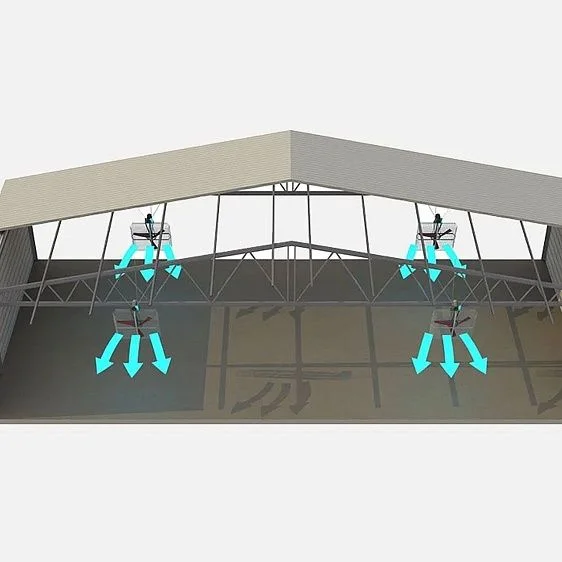
The key purpose of ceiling fans is to mix the air masses inside the room. They are installed on farms with at least 50 cows. The design of the devices is quite large, so the blades are able to move large flows of air masses and evenly distribute fresh air inside the structure.

Without ventilation, the air masses "do not move", forming stagnant zones, which is why the composition and temperature of the air become heterogeneous and vary in different areas of the room, depending on the zones and the height of the ceilings. Ceiling fans (like a mixer) mix air masses, equalizing its composition and temperature.

Ceiling fans have a limited range of action, which depends on the length of the blades. Therefore, the effective placement of ceiling fans in the cowshed involves the use of several fans, which are installed in parallel above the feeding tables, or in a row above the central aisle. This will be effective in the off-season and winter as a solution to the problems of high humidity and gas pollution in the room. The beds, as well as the stalls, always remain dry. The number of microbes in the room is reduced.

Completed projects

All projects

Equipment

All Equipment

Do you have any questions or need a consultation?

img: Do you have any questions or need a consultation?