Onion Storage Systems for Hot and Humid Climates
Expert perspective: Alexander Samsonov, Agricultural Storage Engineer. View LinkedIn profile.
Engineering note: onion storage must be designed around the local climate, variety, harvest condition and route to market. ICAR-DOGR has demonstrated a controlled warm-storage approach at 27 ± 2 °C and 60–65% RH, while long-term cold-storage guidance commonly uses conditions near 0 °C and 65–70% RH for suitable dry-onion cultivars. These are different operating strategies, not interchangeable recipes.
Onion Storage: How to Keep Your Harvest Fresh and Profitable All Year Round?
Maximizing onion shelf life starts with the right storage design and a precisely engineered microclimate system.
A properly ventilated facility minimizes post-harvest losses and preserves the product’s original quality, color, and weight - ensuring your crop remains market-ready even months after harvest.
Agrovent solutions are designed to work effectively across diverse climates - from the hot, dry conditions of Saudi Arabia to the humid regions of India and tropical Africa.

Four Key Stages of Onion Storage
1. Drying (Curing Phase)
The first and most critical stage for onion preservation is thorough drying.
Freshly harvested onions retain a high level of internal moisture. This moisture must be removed quickly to prevent neck rot and bacterial infection — especially in warm or humid environments.
At this stage:
- Warm, dry air (2–3 °C higher than bulb temperature) is supplied evenly through the ventilation system.
- Product temperature is gradually increased up to 20 °C, promoting moisture evaporation.
- When onions are harvested green or under wet conditions, the drying air temperature can be safely raised to 30 °C to accelerate the process.
- Avoid keeping the product between 22 °C and 25 °C, as this range encourages neck rot development.
- Ventilation duty cycles should respond to bulb temperature, humidity and exhaust-air conditions rather than follow one fixed timetable for every batch.
2. Temperature Equalization
Once the outer layers are dry, onions must continue ventilating with either inside or outside air to ensure even drying throughout the pile or container.
Airflow must be calculated from the storage method, bulk depth, duct resistance, bulb condition and curing objective.
This prevents fungal growth and maintains consistent quality before long-term cooling begins.
3. Gradual Cooling
After curing, the product should be cooled according to a project-specific schedule that limits condensation and temperature gradients. Outdoor-air use, refrigeration stages and recirculation periods must be controlled from measured bulb and air conditions.
4. Long-Term Storage
Once curing and stabilization are complete, the selected long-term storage strategy can begin.
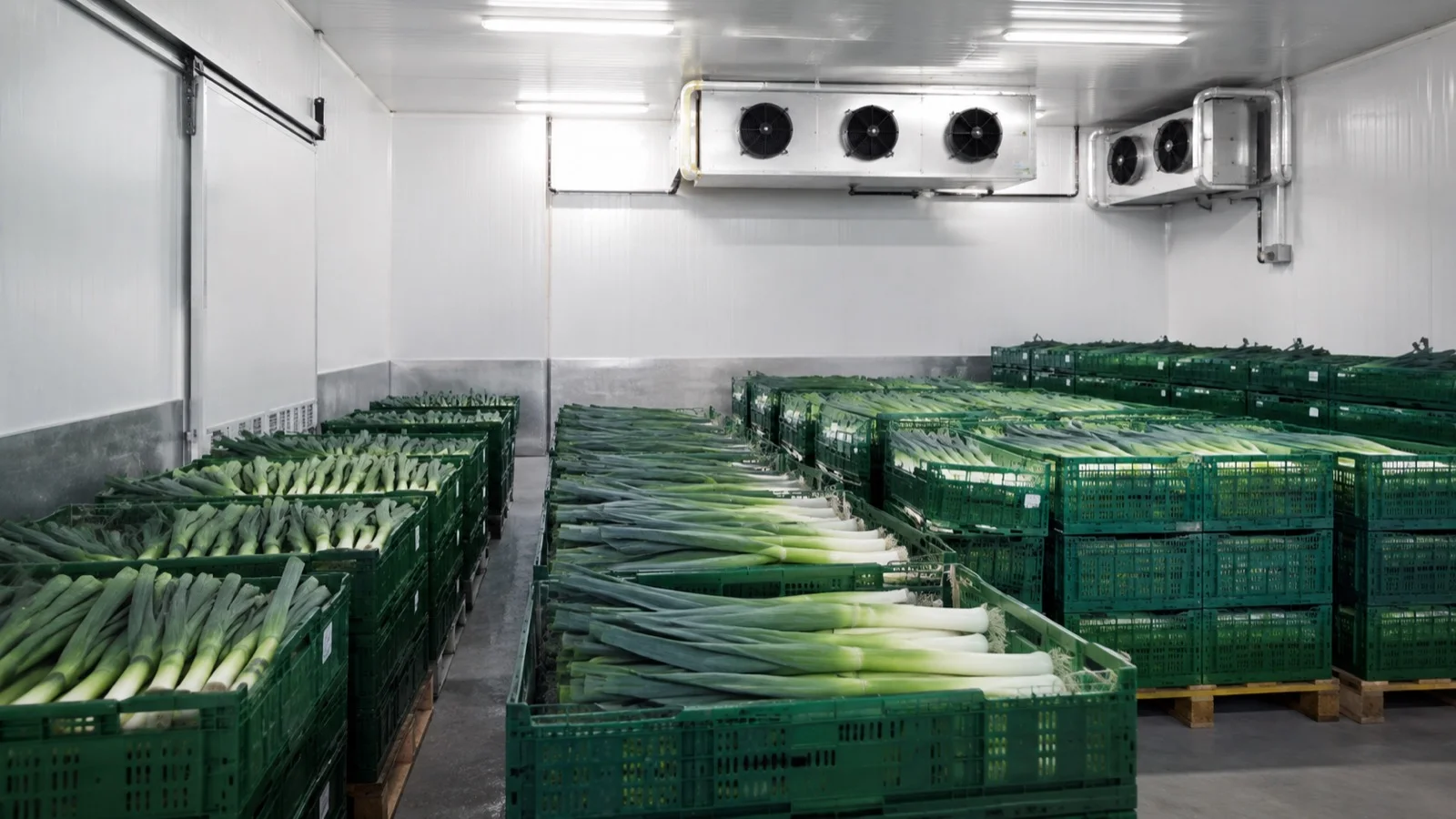
The ideal storage conditions are:
- Temperature: 0 °C to +1.5 °C
- Relative humidity: typically 65–70%, adjusted for variety and operating strategy
- Uniform airflow: to avoid temperature gradients within the pile
A stable microclimate prevents sprouting, dehydration, and decay — supporting long-term storage when the onion variety, curing quality and facility operation are suitable.
Agrovent cooling and ventilation systems designed to automatically maintain these parameters, adapting to local climate and energy conditions. Whether you operate in a tropical, arid, or variable climate, Agrovent ensures reliable performance and extended storage life for your onions.
Why Choose Agrovent for Onion Storage
- Performance measured against the client’s existing storage baseline
- Storage duration designed around variety, market and quality target
- Full climate automation — temperature, humidity, CO₂ balance
- Custom design for local conditions — India, Middle East, Africa
- Energy-efficient and easy to operate
Planning an Onion Storage Project?
Agrovent engineers ventilation, cooling and automatic climate control around the onion variety, harvest condition, storage period, building and local climate. Review our vegetable storage solutions or send your capacity and location to the Agrovent India office on WhatsApp.
Related Agrovent Reading
- Onion Storage Systems for Hot and Humid Climates
- Should India Change Its Onion Storage Culture?
- Microbial Protection for Onions in Maharashtra
Sources and Further Reading



More articles
 African-style potatoes
How potatoes are grown in South and East Africa
News
African-style potatoes
How potatoes are grown in South and East Africa
News
 Floating farms in Bangladesh
Old-new model of farming in the face of climate change
News
Floating farms in Bangladesh
Old-new model of farming in the face of climate change
News
 Carbon farming
Discover how carbon farming practices-reduced tillage, cover crops, agroforestry, and advanced modelling-help agriculture sequester carbon, restore soil health, and reduce global emissions.
News
Carbon farming
Discover how carbon farming practices-reduced tillage, cover crops, agroforestry, and advanced modelling-help agriculture sequester carbon, restore soil health, and reduce global emissions.
News
 Prolonging the life of seeds
These findings are particularly interesting for seed storage in tropical climates, where storage in a cool place is expensive.
News
Prolonging the life of seeds
These findings are particularly interesting for seed storage in tropical climates, where storage in a cool place is expensive.
News
 Protein XXI: plant-based meat analogues
Where can I get protein from and not harm the environment?
News
Protein XXI: plant-based meat analogues
Where can I get protein from and not harm the environment?
News
 Vegetable proteins for life
New vegetable protein products are a variety of options that can satisfy the taste of almost any person.
Vegetable proteins for life
New vegetable protein products are a variety of options that can satisfy the taste of almost any person.

Leave your contacts and we will get back to you