


Relative humidity describes how close air is to saturation at its current temperature. Absolute humidity describes how much water that air actually contains. A storage controller needs both: RH to protect the crop environment, and absolute humidity to decide whether outside air will dry the product or add moisture.
Why RH alone can lead to the wrong ventilation decision
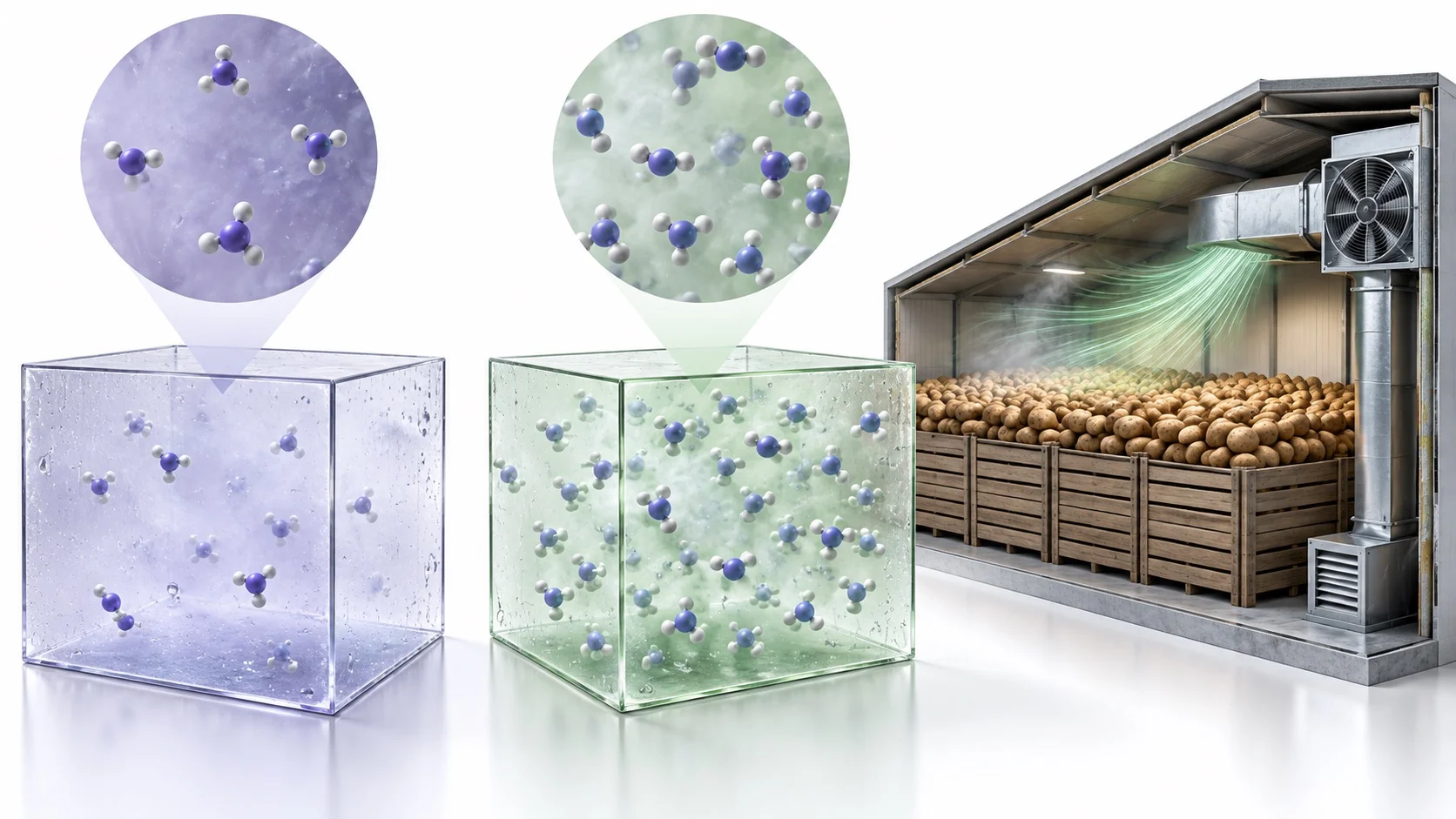
Warm air can contain far more water than cold air. This means that 85% RH outdoors may represent much more moisture than 95% RH inside a cold store. Conversely, cold winter air with apparently high RH can still be extremely dry in absolute terms.
The practical comparison is the humidity ratio between the incoming air and the storage air. If incoming air contains less water, ventilation has drying potential. If it contains more water, the system may add moisture and can create condensation when that air cools.
Temperature changes the meaning of a percentage
RH is a ratio to the maximum moisture capacity at the current temperature. Absolute humidity is the actual mass of water vapour per cubic metre of air.
(inside absolute humidity − outside absolute humidity) × airflow
This provides an engineering estimate, not a complete crop-loss model. Product respiration, leakage, recirculation, surface evaporation and fan operating time also matter.
Three operating scenarios
The values below use standard psychrometric approximation at normal atmospheric pressure. They are rounded for control and operational discussion.
| Scenario | Outside air | Storage air | Difference | At 20,000 m³/h | Control implication |
|---|---|---|---|---|---|
| Small temperature difference | +4 °C, 90% RH about 5.7 g/m³ | +5 °C, 95% RH about 6.5 g/m³ | Outside air is about 0.7 g/m³ drier | Up to about 14 kg/h theoretical drying potential | Ventilation can remove moisture, but long operation may also reduce saleable weight and crop turgor. |
| Hot, humid weather | +28 °C, 85% RH about 23.1 g/m³ | +25 °C, 70% RH about 16.1 g/m³ | Outside air carries about 7.0 g/m³ more water | Potential moisture addition is very high | Do not use outside air without checking dew point and the temperature of crop and surfaces. |
| Cold winter air | −5 °C, 80% RH about 2.7 g/m³ | +3 °C, 95% RH about 5.6 g/m³ | Outside air is about 2.9 g/m³ drier | Up to about 58 kg/h theoretical drying potential | Use short, controlled ventilation cycles and product-temperature limits to avoid excessive dehydration. |
Moisture can appear after the air enters
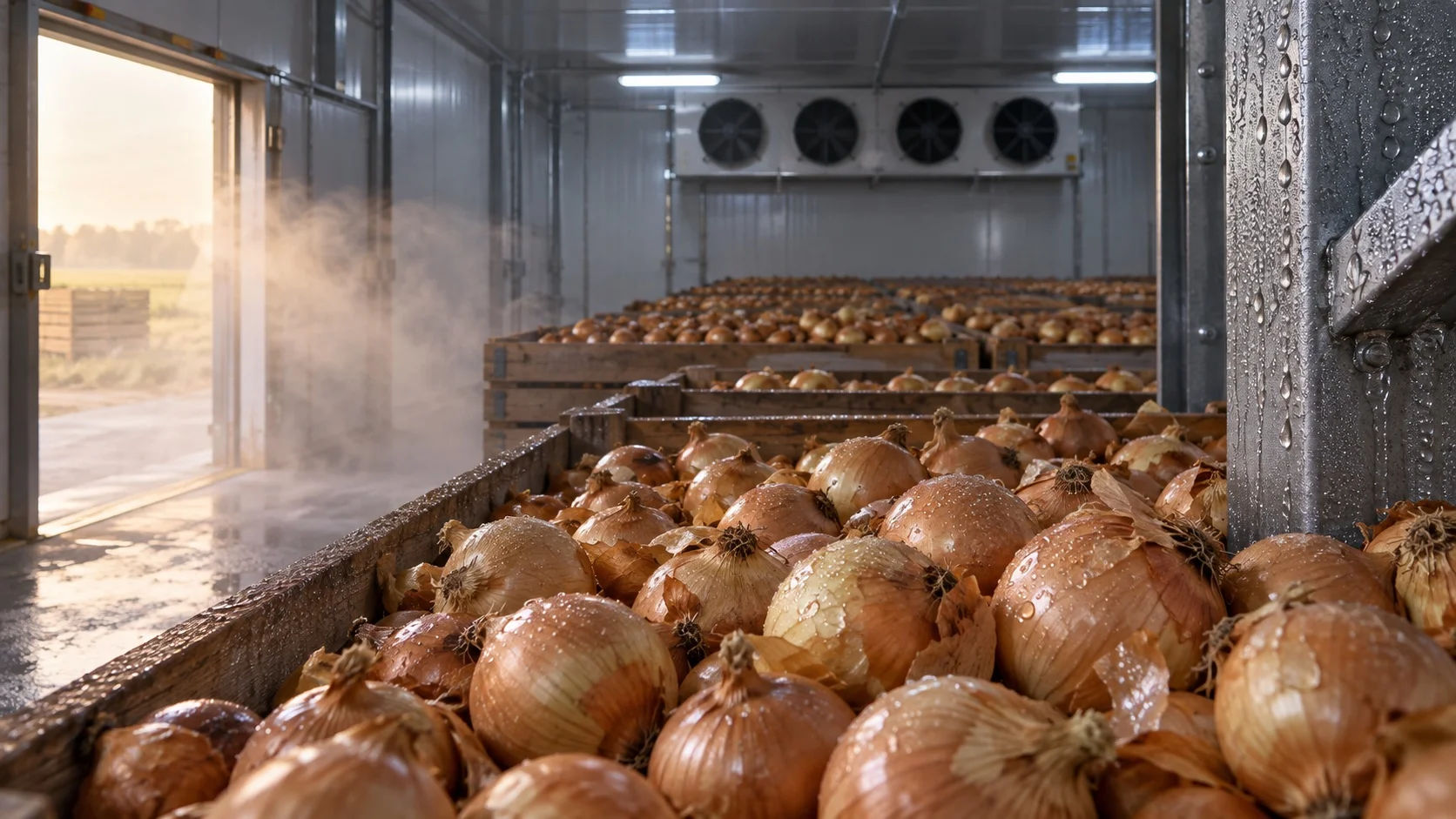
Warm humid air may enter without visible water. When it contacts colder crop, panels, beams or ducts, its temperature falls. If it reaches the dew point, water condenses on the product and building surfaces.
For onion storage this can weaken dry skins and increase disease risk. For potatoes it can create wet zones and uneven storage conditions. That is why a controller must compare dew point with product and surface temperatures, not only read a room RH sensor.
How an automatic storage controller should decide
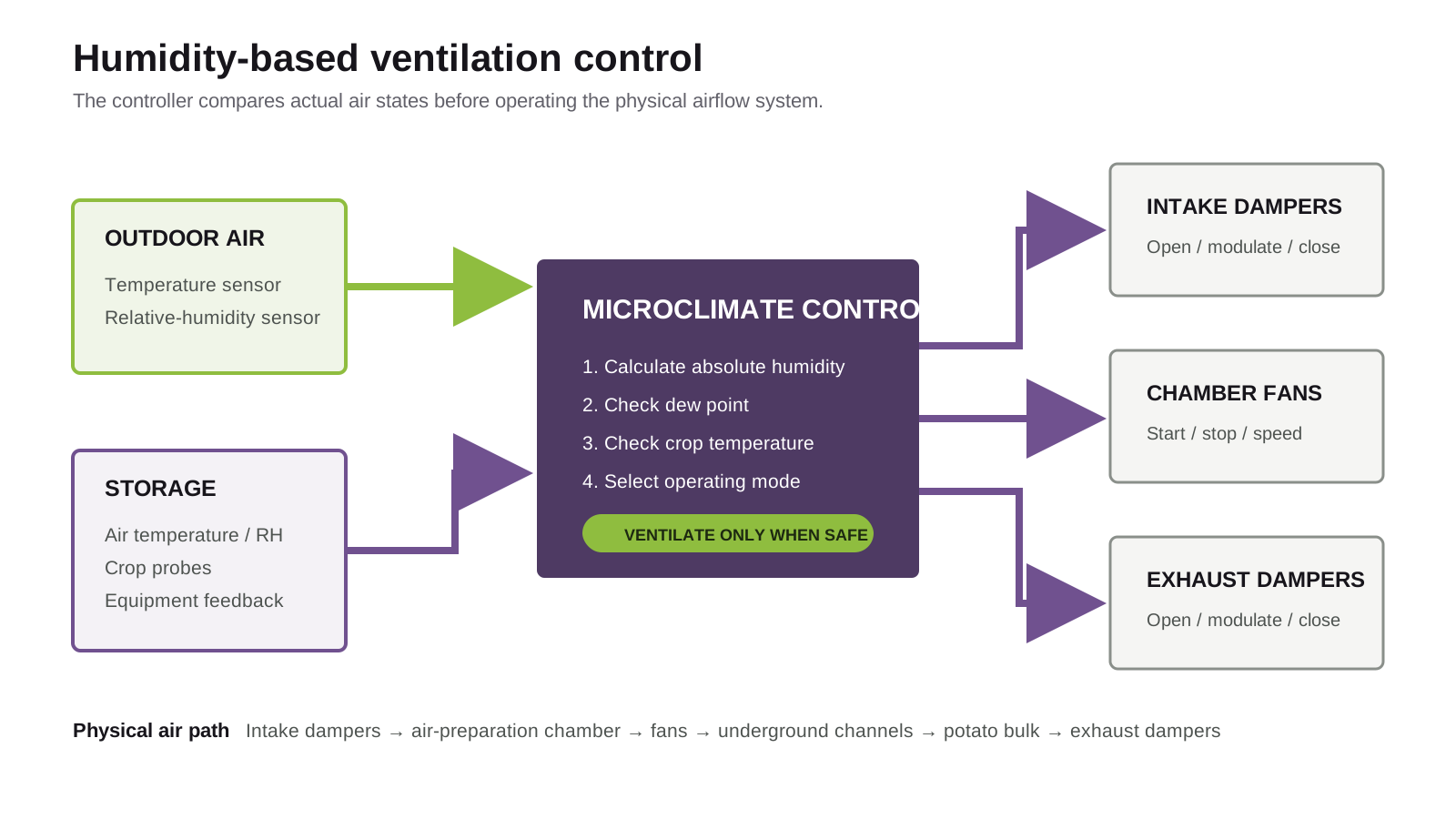
Measure both zones
Use calibrated temperature and RH sensors outdoors, in the pressure chamber, above the crop and, where required, inside the product mass.
Calculate, do not guess
Convert each sensor pair into absolute humidity and dew point, then validate the result against product-temperature limits.
Control the whole system
Coordinate dampers, fans, recirculation, cooling and alarms instead of switching an individual fan from one RH threshold.
Operator checklist
- Verify outdoor and indoor sensors against a calibrated reference.
- Compare absolute humidity before every outside-air ventilation cycle.
- Check dew point against crop, panel and duct surface temperatures.
- Limit drying by crop stage, storage period and acceptable weight loss.
- Record fan runtime, air conditions and product-temperature response.
- Investigate sensor drift when calculated behaviour does not match the crop.
Related Agrovent engineering
Frequently asked questions
Is absolute humidity always more important than relative humidity?
No. Absolute humidity is the better comparison for moisture transfer between two air masses. Relative humidity remains essential for understanding saturation and the storage environment around the crop.
Can high-RH outside air still dry potatoes or onions?
Yes. Cold air at high RH may contain less water than warmer storage air. Once brought inside and warmed, it can have substantial drying capacity.
Why is dew point needed?
Dew point indicates when air will release liquid water on a colder surface. It is critical when warm humid air may contact cold produce or structural elements.
Can theoretical moisture difference predict exact crop weight loss?
Not by itself. It estimates the air stream's potential. Exact product loss also depends on crop resistance, exposed surface area, airflow distribution, leakage, respiration and operating time.
Check the drying and condensation risk in your storage
Send Agrovent the crop, storage capacity, target temperature and RH, outdoor design conditions, fan airflow and available sensor layout. Our engineers can review the ventilation logic and identify where moisture transfer may threaten quality or saleable weight.
Email project data Contact Agrovent


 Farming in space
Why are companies looking for viable farmland off Earth?
Farming in space
Why are companies looking for viable farmland off Earth?  Onion Storage: How Temperature and Humidity Decide Whether Your Crop Survives
Onion storage is more than keeping bulbs in a room - it’s a constant battle against fungi. Every temperature range activates different pathogens, and without precise climate control, even a perfect harvest can deteriorate in weeks. Agrovent explains how to win this battle and keep your onions market-ready all season.
Onion Storage: How Temperature and Humidity Decide Whether Your Crop Survives
Onion storage is more than keeping bulbs in a room - it’s a constant battle against fungi. Every temperature range activates different pathogens, and without precise climate control, even a perfect harvest can deteriorate in weeks. Agrovent explains how to win this battle and keep your onions market-ready all season.  Oh, a wonderful new world: how not to 'become obsolete' in the trends of the future
How climate change, population growth, automation, and digital technologies transform agriculture. Key future professions, essential skills, and why sustainable farming matters
Oh, a wonderful new world: how not to 'become obsolete' in the trends of the future
How climate change, population growth, automation, and digital technologies transform agriculture. Key future professions, essential skills, and why sustainable farming matters  Fast-Build Arch-Type Storage Facilities: A Cost-Effective Solution
In many developing regions, post-harvest losses still reach 20–40%. Traditional warehouses are too expensive and slow to build - but arch-type storage hangars offer a faster, cheaper, and highly effective alternative. Here’s why this model is transforming agricultural supply chains across Africa, India, South and Southeast Asia, and Latin America.
Fast-Build Arch-Type Storage Facilities: A Cost-Effective Solution
In many developing regions, post-harvest losses still reach 20–40%. Traditional warehouses are too expensive and slow to build - but arch-type storage hangars offer a faster, cheaper, and highly effective alternative. Here’s why this model is transforming agricultural supply chains across Africa, India, South and Southeast Asia, and Latin America. 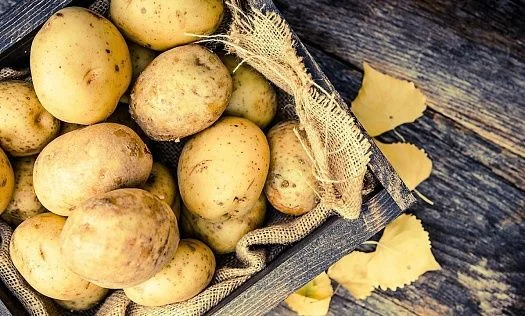 Potatoes. Storage parameters
Learn optimal potato storage conditions: temperature, humidity, CO₂ control, and bulk height. Engineered solutions for India, Africa, and Saudi Arabia.
Potatoes. Storage parameters
Learn optimal potato storage conditions: temperature, humidity, CO₂ control, and bulk height. Engineered solutions for India, Africa, and Saudi Arabia.  11 new technologies that will soon appear in the kitchen
What will the kitchen of the future look like?
11 new technologies that will soon appear in the kitchen
What will the kitchen of the future look like? 
