Storing peaches

How do you preserve peaches without bruising, condensation, or rapid spoilage? We break down the full technology - from harvest maturity to ULO storage - so your fruit stays firm, sweet, and market-ready for weeks.
Harvesting: Getting Maturity Right
Correct harvest maturity is the foundation of successful peach storage. One of the most reliable indicators is sugar content, ideally around 11°Bx, though values may vary by variety. Tools such as optical ripeness analyzers and penetrometers help determine optimal harvest time; firmness of 2.4–2.7 kg/cm² means the peach is ready.
Harvesting Rules
-
Do not let harvested fruit remain in the sun - even in shade, prolonged exposure is risky.
-
The optimal harvest window is mid-August to early September.
-
Harvest early in the morning, when temperatures are below 12°C.
-
Never harvest peaches when dew is present.
Early and mid-season varieties rarely store well - hot climate harvesting limits temperature control. Late varieties perform significantly better.
Large fruits are more easily damaged and deteriorate faster. Medium-sized peaches (180-200 g) store best.
How to Pick Peaches Safely
Peaches bruise extremely easily. Wrap your whole palm around the fruit and gently twist — never pull.
When stacking, use no more than 5 layers (ideally 2) in 5–10 kg crates.
Cooling: Protecting the Pit, Not the Flesh
The goal of cooling is to rapidly cool the pit, which stops ripening (anthogenesis).
Mobile cooling tunnels can be used in the orchard for short-term sales, but this is not recommended for long-term storage — the cold chain almost always breaks during transfer, leading to condensation and spoilage.
Rule:
The shorter the distance from orchard to storage room, the better.
Peaches prepared for long-term storage must be preconditioned:
-
Hold 24–48 hours at 10–15°C
-
Resort and remove damaged fruit
-
Begin gradual cooling: no more than 5°C per day
Storage: Microclimate Makes or Breaks the Batch
Peaches have intense respiration, and this depends on:
-
maturity
-
temperature
-
humidity
-
gas composition
-
damage level
-
storage duration
Damaged fruit respire more actively — one spoiled peach accelerates spoilage of the entire lot. A storage facility cannot “heal” fruits.
Optimal Storage Parameters
-
Best method: ULO (Ultra-Low Oxygen)
-
Oxygen: 1.5–2%
-
CO₂:
-
Some varieties: 2–3%
-
Others tolerate 9–10% (but shelf life decreases)
-
Temperature Uniformity Is Critical
Peaches are extremely sensitive to temperature differences.
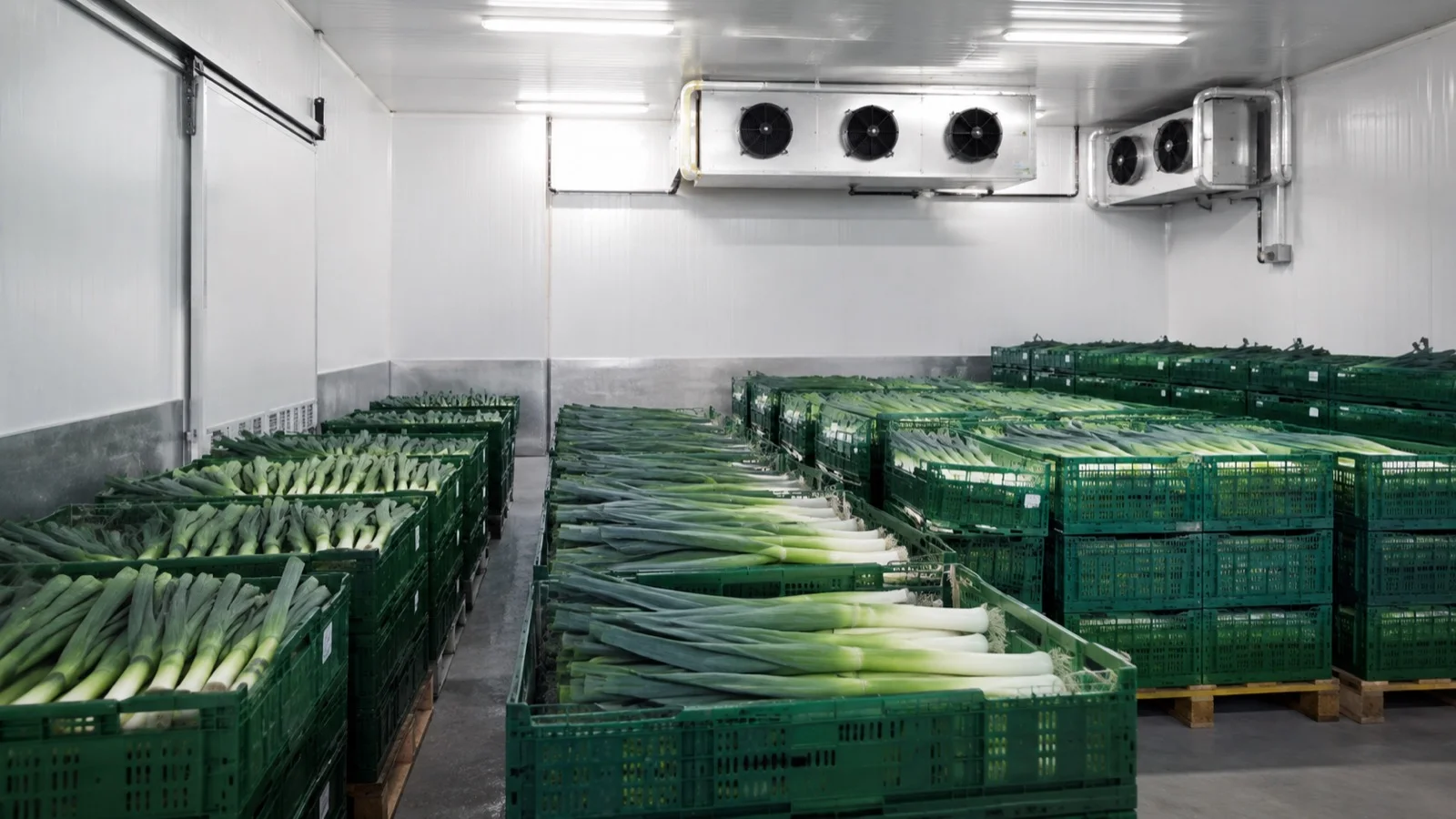
The allowed differential is ≤0.2°C between the warmest and coldest points in the room.
Small chambers maintain uniformity much better.
Humidity
-
Optimal: 87–93%
-
Above 93% → condensation, mold
-
Below 87% → dehydration, shriveling
Presale Preparation
Whenever possible, store peaches in the same crates used for retail to avoid unnecessary handling.
Perforated boxes with no paper inserts provide good air circulation.
If repacking is necessary, it must be done inside a cold room to avoid breaking the cold chain.



More articles
 Apple Storage: How Controlled-Atmosphere (CA) Technology Extends Shelf Life and Profitability
Harvesting apples is only half the job - keeping them fresh is where the real challenge begins. Learn how modern cooling and Controlled-Atmosphere (CA) storage can protect your apples from spoilage, preserve nutrients, and keep your profits growing all year long.
News
Apple Storage: How Controlled-Atmosphere (CA) Technology Extends Shelf Life and Profitability
Harvesting apples is only half the job - keeping them fresh is where the real challenge begins. Learn how modern cooling and Controlled-Atmosphere (CA) storage can protect your apples from spoilage, preserve nutrients, and keep your profits growing all year long.
News
 How to store carrots in a vegetable store?
Ventilation and cooling of vegetable storage of carrots, as a guarantee of efficient crop storage
News
How to store carrots in a vegetable store?
Ventilation and cooling of vegetable storage of carrots, as a guarantee of efficient crop storage
News
 Post-harvest processing and cooling of berries
How to extend the shelf life of a berry crop?
News
Post-harvest processing and cooling of berries
How to extend the shelf life of a berry crop?
News
 Global Onion Storage Guide: Temperatures, Humidity, Ventilation & Regional Best Practices
Learn how to store onions safely for 6-10 months using bulk or container systems. Explore temperature, humidity, airflow requirements, varieties, harvest maturity, and regional practices across Europe, India, Africa, and South America.
News
Global Onion Storage Guide: Temperatures, Humidity, Ventilation & Regional Best Practices
Learn how to store onions safely for 6-10 months using bulk or container systems. Explore temperature, humidity, airflow requirements, varieties, harvest maturity, and regional practices across Europe, India, Africa, and South America.
News
 Technologies and methods for storing Jerusalem artichoke tubers
Learn the best technologies for storing Jerusalem artichoke (sunchoke) in hot climates. Long-term storage methods, cooling solutions, humidity control and expert guidance for India, Africa and Saudi Arabia. Contact Agrovent for professional vegetable storage systems.
News
Technologies and methods for storing Jerusalem artichoke tubers
Learn the best technologies for storing Jerusalem artichoke (sunchoke) in hot climates. Long-term storage methods, cooling solutions, humidity control and expert guidance for India, Africa and Saudi Arabia. Contact Agrovent for professional vegetable storage systems.
News
 Carrots. Storage parameters
Preparation of the product. The volume of goods. Storage temperature.
Carrots. Storage parameters
Preparation of the product. The volume of goods. Storage temperature.

Leave your contacts and we will get back to you