Farm Monitoring & Climate Intelligence

Explore farm monitoring and climate analytics with Agrovent. Connect equipment data, investigate deviations and discuss a pilot for your production site.

Agrovent engineering · Agilias intelligence

Understand what is happening inside your farm

Connect climate readings, equipment status and production observations to investigate deviations and support better operating decisions.

Start with one building and one practical question. Agrovent can help define the engineering scope; the Agilias direction brings operational analytics and computer vision into that discussion.

Discuss your siteExplore a pilot

Integration and deliverables are agreed after reviewing your equipment and available data.

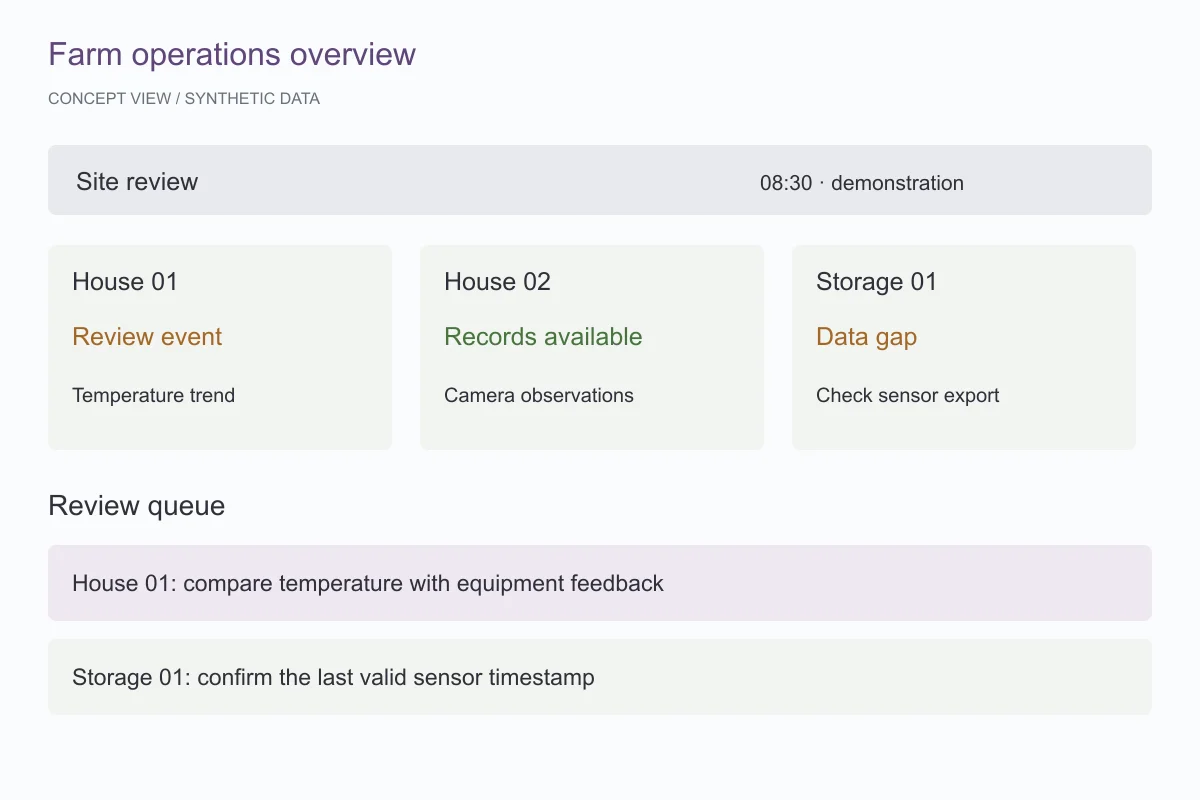
Illustrative farm overview showing room status, data gaps and events awaiting review
Concept interface with synthetic data. It illustrates the proposed workflow, not a released software screen.

Start with an operational question

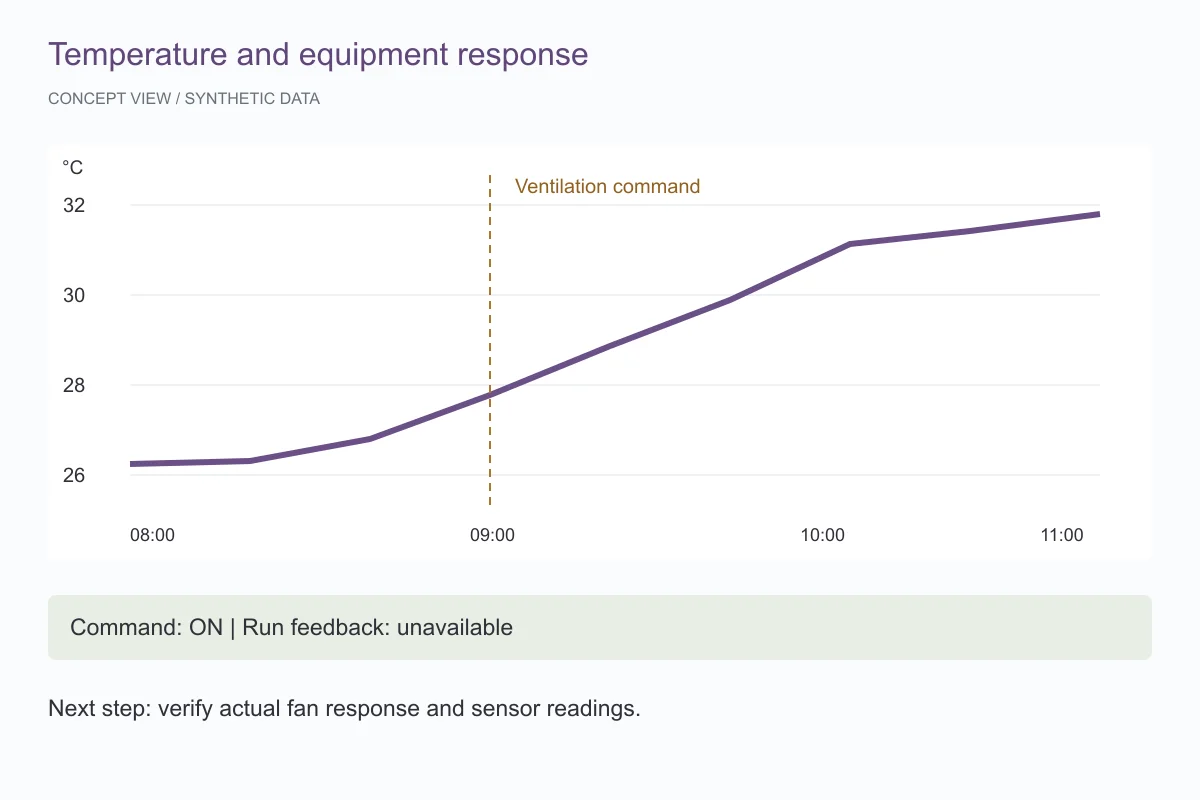
Temperature rises while ventilation is on

Compare the temperature trend with outdoor conditions, fan commands, available run feedback and inlet positions. A command to run does not prove that airflow has been delivered.

The review can identify what to inspect next: a drive fault, restricted inlet, dirty equipment or a sensor issue. A site check is needed to establish the cause.
Climate looks normal, but the flock is uneven

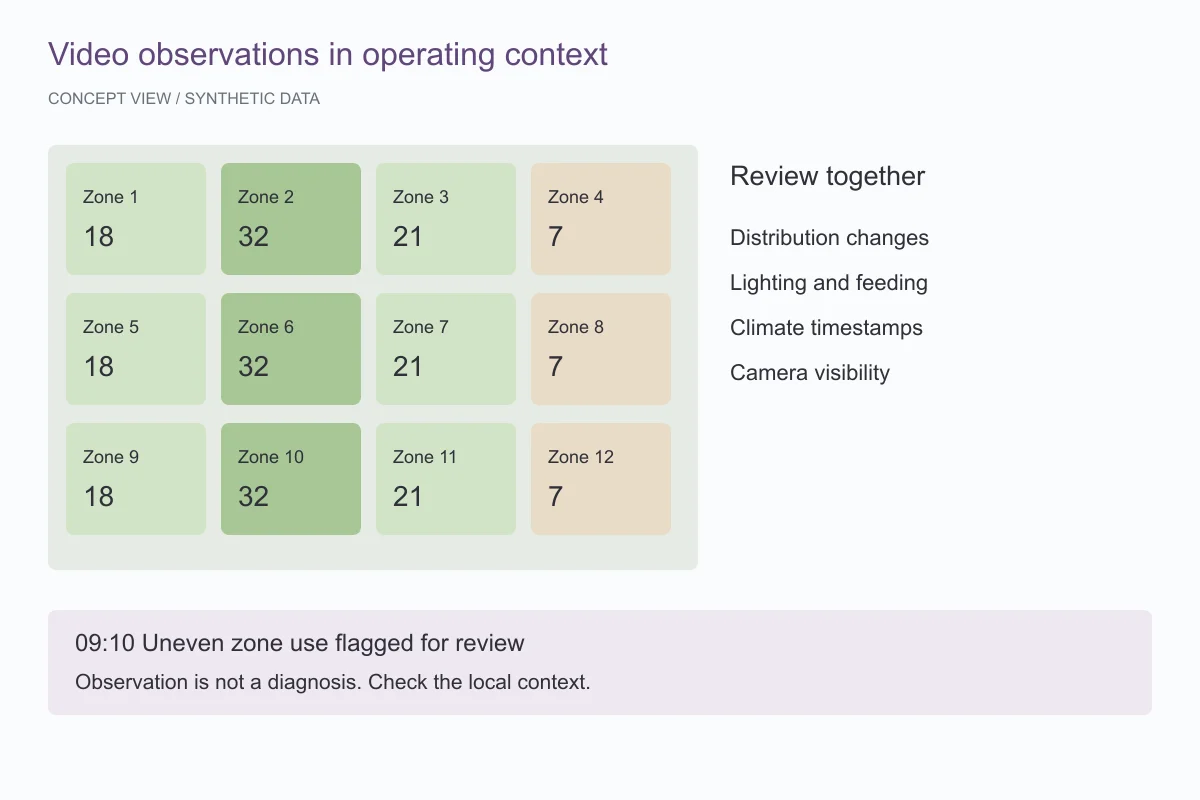
A single sensor does not describe every occupied zone. Video observations can help locate persistent crowding or empty areas and place them on the same timeline as climate readings.

Lighting, feeding routines, age and camera visibility must be considered before interpreting behaviour.

Storage energy use increases

Review operating hours, outside weather, loading changes and temperature targets. If metering is available, compare energy use across comparable periods and quantities of stored product.

Longer runtime alone is not evidence of wasted energy. The analysis should distinguish changing demand from an equipment or control problem.

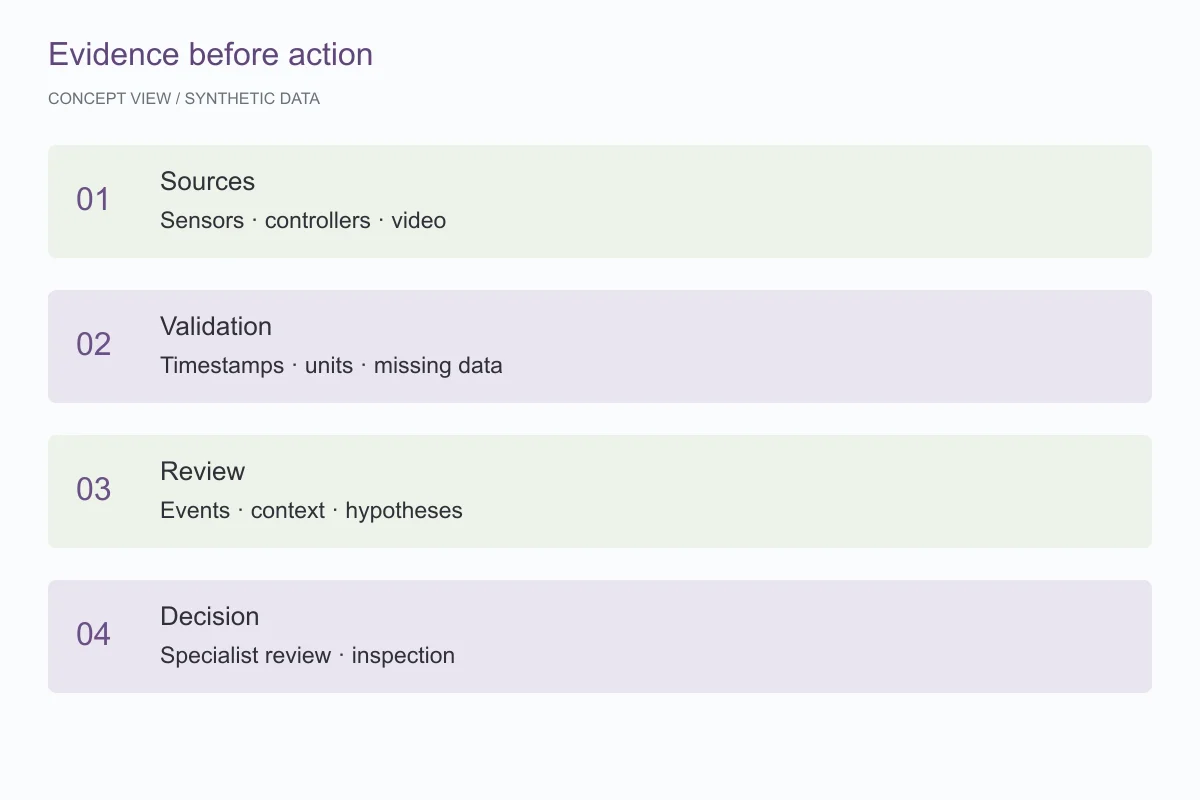
Workflow from sensors and controllers through data validation and analysis to a specialist decision
Proposed monitoring workflow. Local controllers and protective functions remain responsible for equipment operation.

From equipment signals to a traceable decision

Useful analysis starts with reliable inputs. We first identify which signals exist, how they are recorded and whether their timestamps can be aligned.

Missing values, frozen readings and differences in units need to be visible. A gap in the data should never appear as a healthy operating condition.

The next step is a reviewable event: what changed, which evidence supports it, what remains uncertain and who should investigate. Automated control changes require a separately engineered and approved scope.

Explore Agrovent sensors, climate controllers and power control panels.

Investigate an event, not just a number

A trend becomes useful when it is connected to operating context. In this illustrative event, the room temperature keeps rising after a ventilation command. That is a reason to review the actual equipment response, not an automatic diagnosis.

A practical event record should include the start time, affected room, measured values, relevant equipment states, operator observations and the next inspection step.

For an engineer, this supports troubleshooting. For a production manager, it provides a record of the response. For an owner, it creates evidence for deciding which improvements deserve investment.

Synthetic temperature trend aligned with a ventilation command and an unresolved feedback signal
Illustrative event using synthetic data. Temperature values are not husbandry recommendations or alarm limits.

Agrovent and Agilias: one connected engineering discussion

Physical systems

Agrovent supplies agricultural climate engineering and automation. Sensor placement, airflow, electrical design and commissioning determine whether the underlying system is dependable.

Operational intelligence

Agilias is the related technology direction for operational analytics, digital models and computer vision. The scope for a particular site depends on its data and the maturity of the required module.

People and responsibility

Engineers and production specialists interpret findings, verify causes and approve operating changes. The proposed diagnostic pilot does not replace local safety functions or qualified decisions.

Illustrative flock distribution zones and timeline showing how video observations can be compared with climate data
Concept view with synthetic zone counts and events. Camera coverage and visibility affect what can be observed.

A specific starting point: poultry video audit

The ValentinaCV pilot is described as a seven-day behaviour audit for one broiler house using one or two cameras. Its focus is activity, flock distribution, empty zones, crowding and periods worth reviewing.

Camera angle, lighting and image quality are checked first. Available climate records can provide additional context, subject to their quality and time alignment.

The output is a structured report and a discussion with the technical team. It does not establish a veterinary diagnosis or control equipment.

Read why poultry data can miss what the birds are telling us and explore our poultry engineering solutions.

Build the scope around your production site

For vegetable storage, a useful investigation may focus on uneven temperatures, CO2 history, ventilation cycles or refrigeration runtime. Crop type, loading pattern and storage stage provide essential context.

For poultry, the question may concern room conditions and behaviour. For other livestock or greenhouse sites, monitoring priorities must be defined with the production specialist before applying an analytical model.

Existing equipment can be reviewed for integration. We need controller models, accessible data exports or interfaces, sensor details and network constraints before confirming compatibility. Offline operation, retention, access rights and notification channels are agreed for the project.

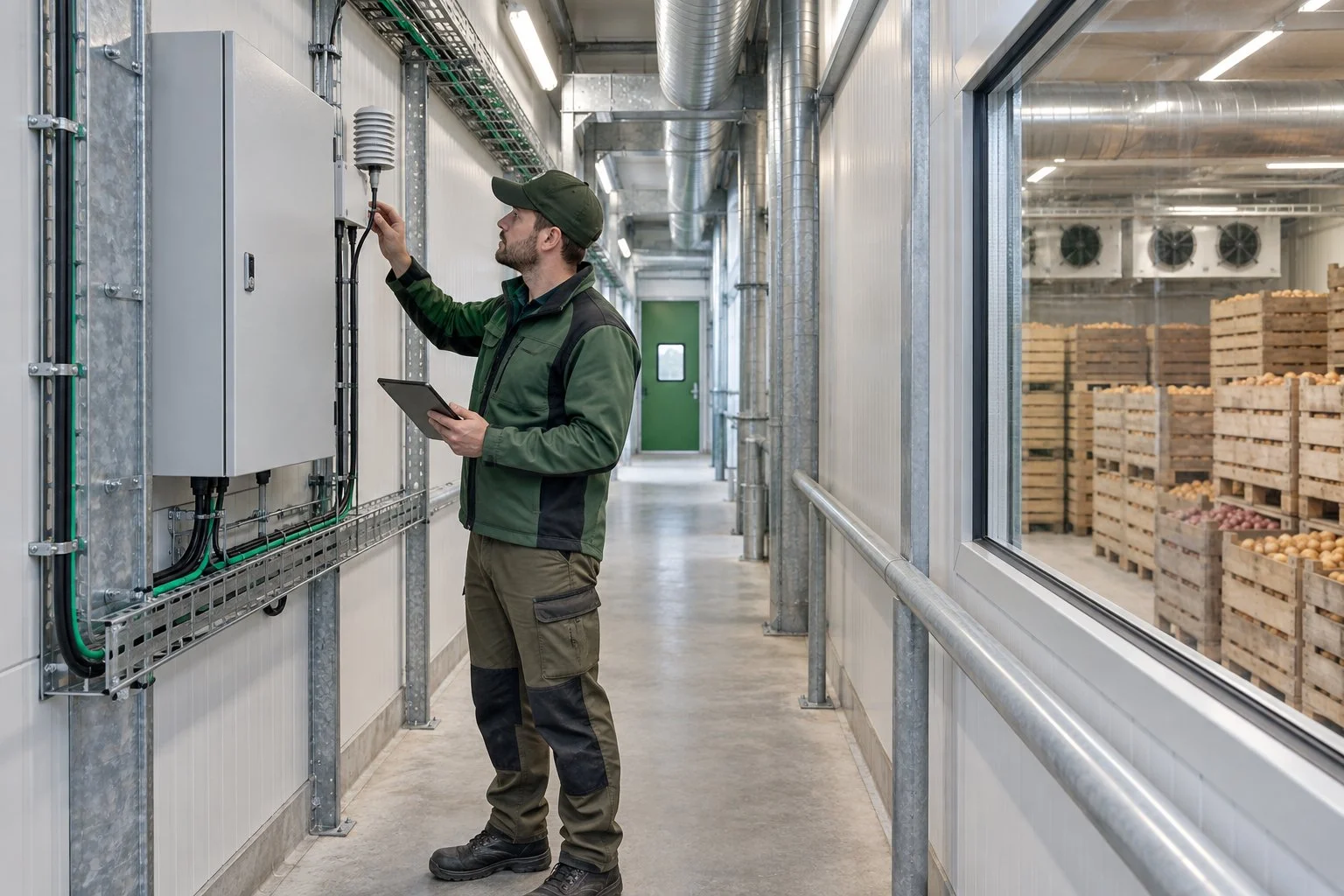
Illustration of an agricultural engineer inspecting monitoring equipment beside a crop storage room
AI-generated engineering illustration; not a photograph of a completed customer installation.

Begin with one room and a measurable pilot

1. Define and verify

Choose an operational question, the people responsible and the observation period. Review source quality, timestamps, permissions and the equipment inventory.

2. Observe and investigate

Collect the agreed records, identify gaps and review deviations with site staff. Document hypotheses separately from verified findings.

3. Evaluate and decide

Review the findings, workload and usefulness of the report. Agree whether to improve data collection, extend the pilot or connect another building.

Agree the deliverables before starting

  • A register of the included data sources and their limitations.
  • A time-based record of the agreed parameters or video observations.
  • A reviewed list of events with evidence and follow-up questions.
  • Recommendations, responsible people and a closing technical discussion.

Possible evaluation measures include usable data coverage, time needed to review an event and time spent preparing reports. Claims about energy savings, productivity or loss reduction require a suitable baseline and comparable operating conditions.

Questions before connecting a site

Does the pilot automatically control equipment?

No. The diagnostic scope described here supports review and decisions. Equipment control requires a separate engineering assessment, safeguards and agreed commissioning procedure.

Can we use existing controllers and cameras?

Potentially. Compatibility is confirmed after checking controller models, exports or interfaces, camera access, image quality and network conditions. There is no universal compatibility promise.

What should we send for an initial discussion?

Describe the production site and the problem. Include equipment models, available records, the number of rooms and who will review the findings. Agree a suitable transfer method before sending sensitive operational data.

Is Agilias a complete autonomous farm controller?

Agilias is the related industrial intelligence direction. The scope on this page is a discussion of monitoring and diagnostic integration, with capabilities confirmed for each project.

Can you guarantee a percentage saving?

No fixed saving is promised. A pilot should first establish data quality and useful findings; financial impact requires measurement against a comparable baseline.

Which operational question would you like to answer?

Tell us about your site, the equipment already installed and the deviation that is hardest to explain. We can start by defining what evidence would make the next decision easier.

Discuss your siteExplore Agilias
Any questions? We are always in touch!

Leave your contacts and we will get back to you

img: test 123