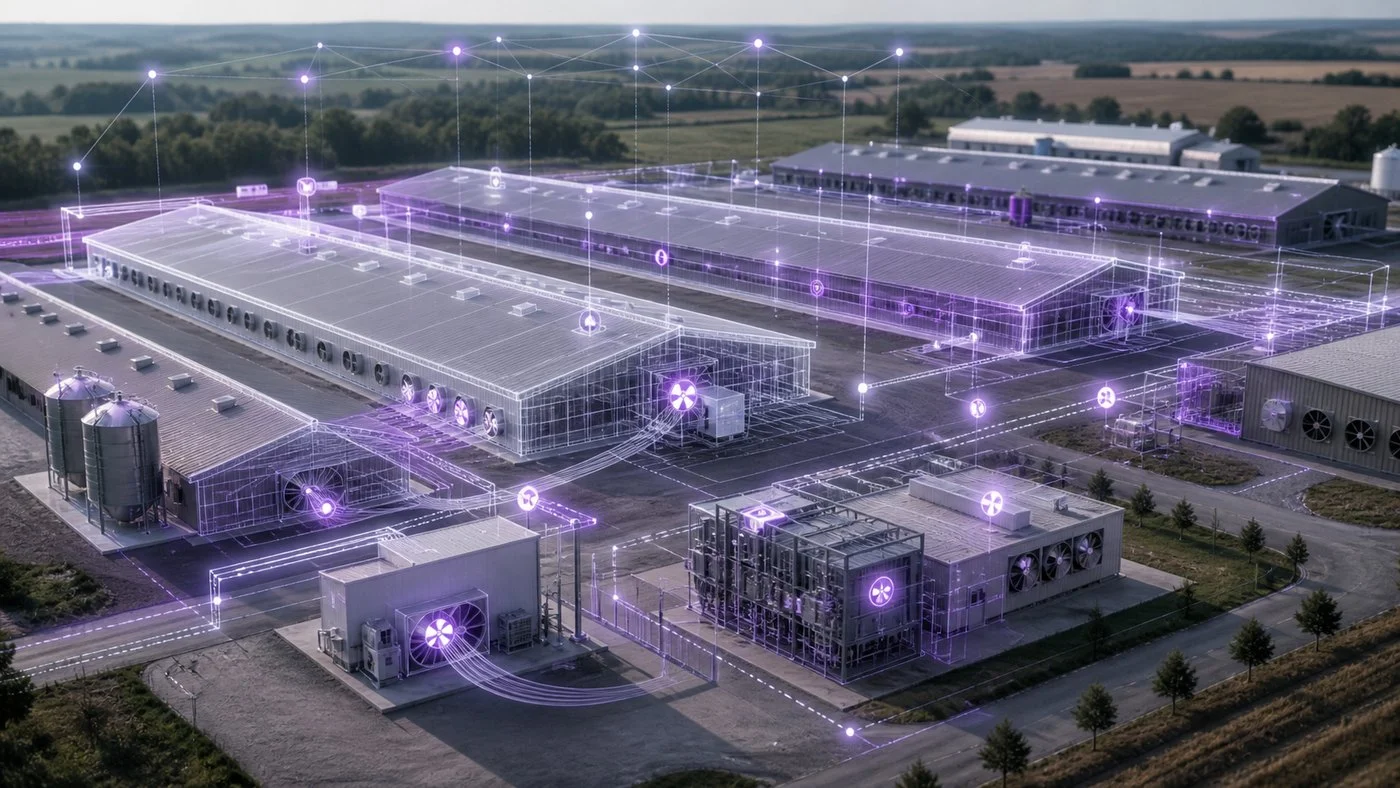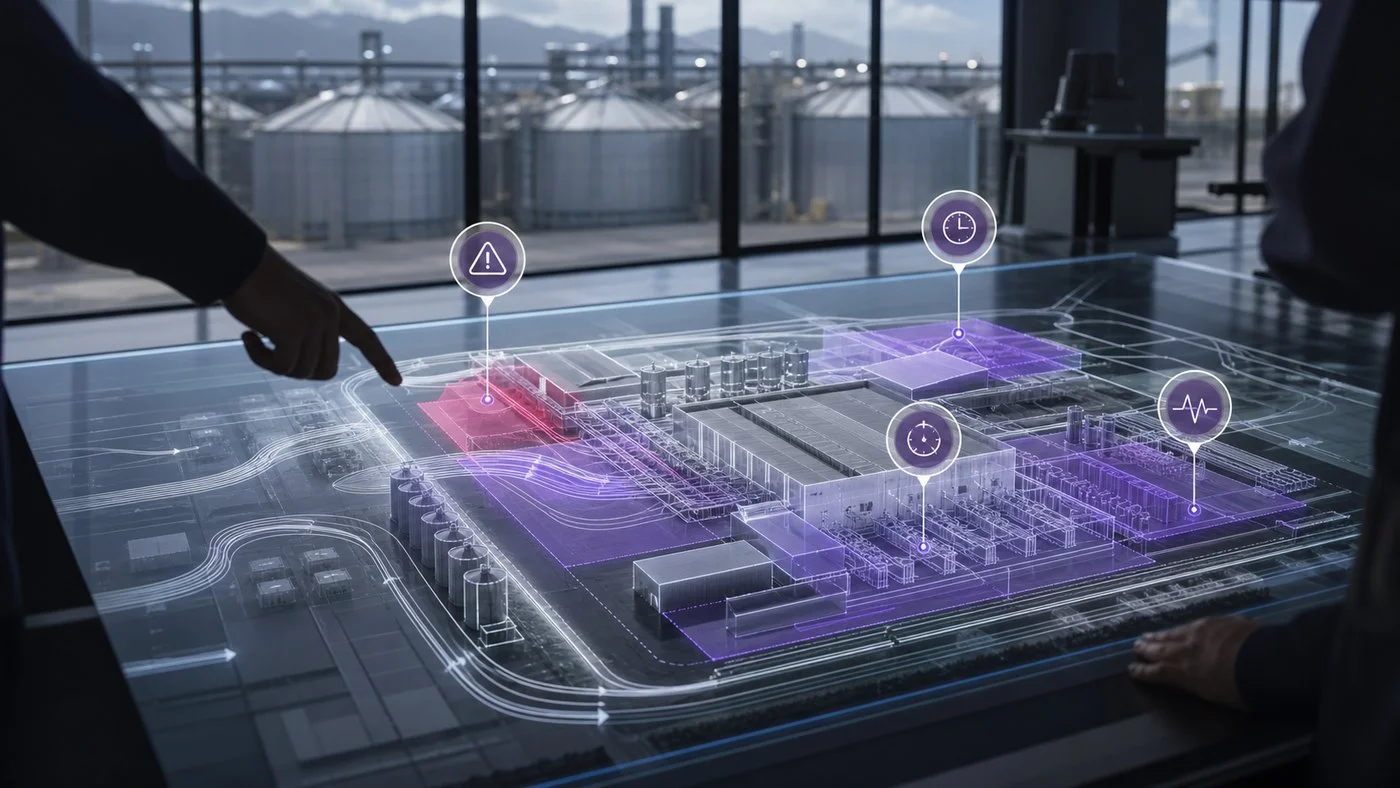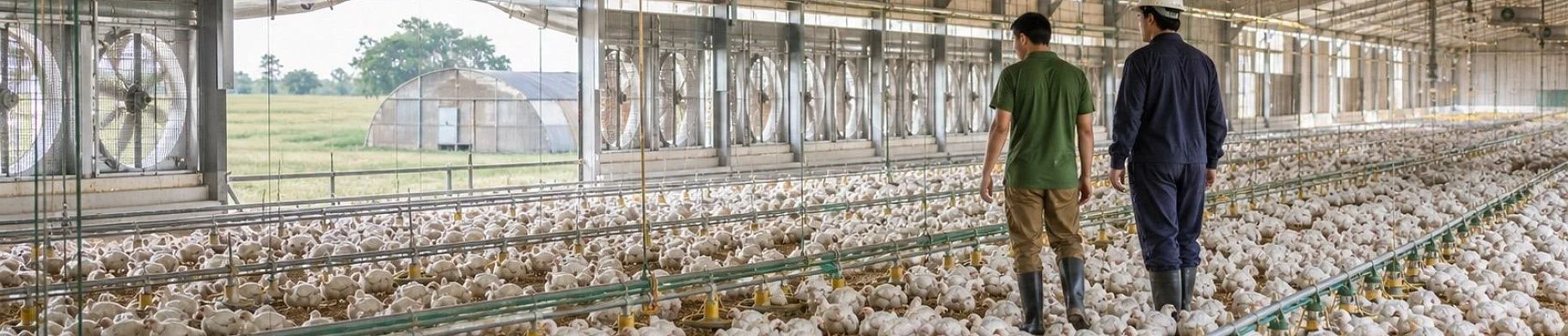
There is no single global poultry production model. A vertically integrated company in the United States, a contract broiler grower in India, a welfare-led European producer and an independent farm in Africa may use very different buildings, equipment, labour and decision processes.
Yet they share one operational problem: climate systems primarily measure the house and the equipment. The flock's response is still interpreted through farm visits, CCTV review, production results and human experience.
One industry, several production realities
Global poultry production is industrial at the level of genetics, feed, veterinary standards and processing, but it is highly diverse at farm level. The data architecture that works for a centralised integrator is not automatically suitable for an independent grower, and a technology that requires a corporate control room will not fit thousands of dispersed contract farms.
Integrated and contract networks
In the United States and Brazil, large integrators coordinate breeding, feed, veterinary programmes, processing and market access, while birds are often raised on dedicated contract farms. The challenge is consistency across many houses, growers, controller generations and local operating practices.
European commercial farms
European production combines commercial scale with increasingly formal welfare, environmental and traceability requirements. This raises the value of objective animal-based indicators, but also demands transparent interpretation rather than unexplained automated decisions.
India's mixed production structure
India combines sophisticated integrated businesses, contract growers, independent commercial farms and a large backyard poultry segment. Technology must therefore be modular: useful in one house first, able to operate with existing cameras, and capable of scaling only where the economics are proven.
Independent and family poultry systems
Across Africa, Asia and Latin America, family poultry remains important for income and food security. Full computer-vision monitoring is not the first priority for every small flock, but the commercial farms, hatcheries, breeding operations and cooperatives that connect these markets still need practical ways to improve climate management.
The common blind spot: the controller does not see the flock
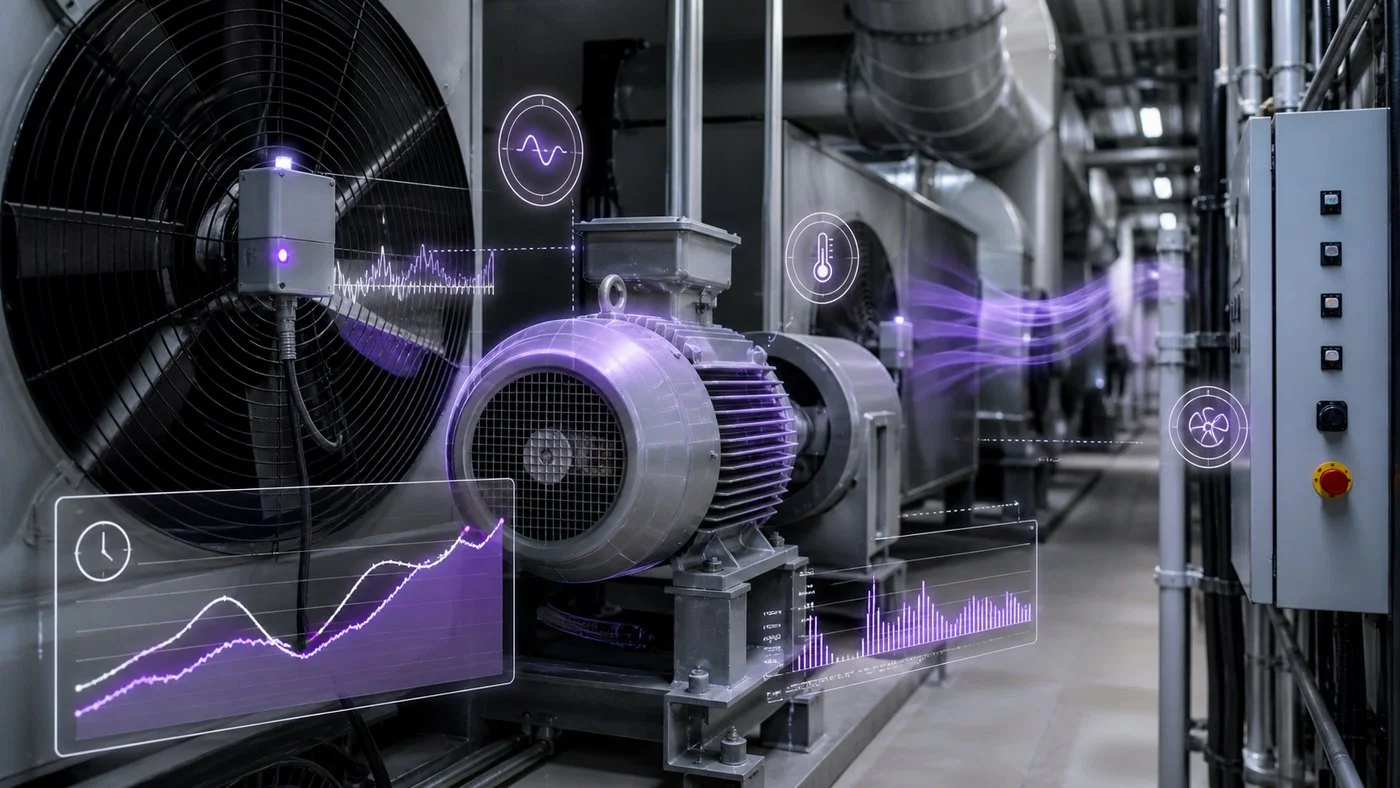
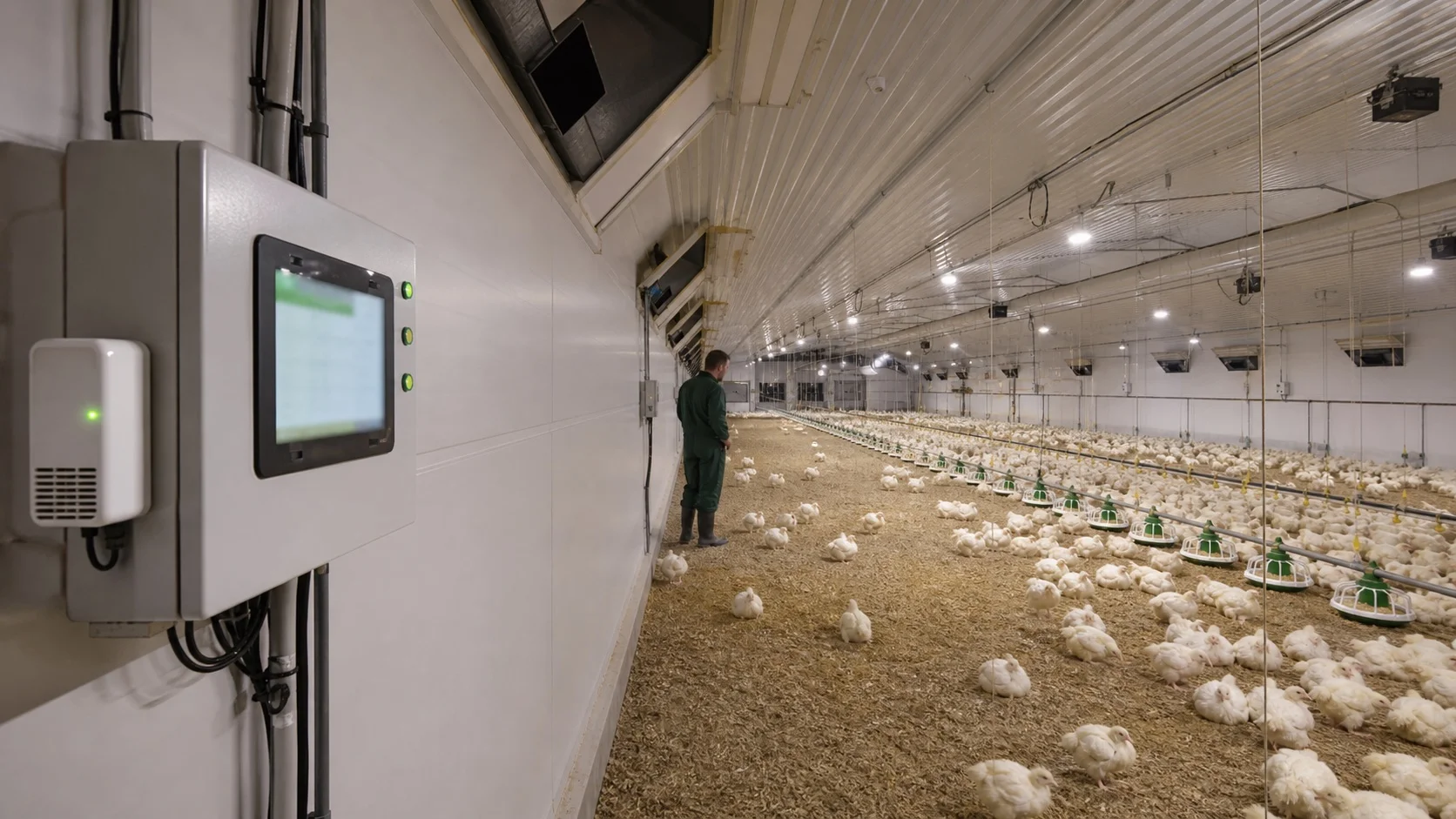
A climate controller can know the temperature near a probe, relative humidity, carbon dioxide at a measuring point, static pressure, fan stages and alarm status. These are essential variables. They do not, however, directly describe how thousands of birds experience the combined result at floor level.
Local cold-air drop, poor mixing, solar gain, wet litter, differences in air velocity, light distribution or equipment obstruction may create zones that birds avoid. The average house temperature can remain within target while flock distribution becomes uneven.
This is not a failure of climate automation. It is a limitation of the data layer. Sensors describe physical conditions at selected points; birds integrate the total environment continuously and express the result through movement, resting patterns, crowding and use of space.
Why the problem looks different by market
For an integrator: comparability across houses
The central question is not whether a single controller works. It is whether operations can compare houses and sites that use different hardware, ages, building designs and farm teams. Behavioural indicators can provide a common reference because they start with the flock rather than the controller brand.
For a contract grower: actionable evidence
The grower needs a practical answer: when did distribution change, where did birds move, and what should be checked first? A complex platform with dozens of dashboards adds little value if it does not shorten the path from observation to action.
For welfare-led production: animal-based evidence
European welfare science increasingly emphasises animal-based measures alongside resource and management measures. Camera-derived behaviour cannot replace formal welfare assessment, but it can help make continuous observation more objective and direct attention to periods that require human review.
For emerging commercial farms: a modular entry point
Many farms cannot replace their automation system simply to improve analytics. Existing CCTV and a limited-duration audit create a lower-risk starting point: analyse one house, establish whether the video contains useful signals, and expand only after operational value is demonstrated.
What a useful technology must not pretend
Behaviour is a signal, not a diagnosis. Crowding may be associated with thermal discomfort, a draught, lighting, equipment access, disturbance or another cause. A responsible system should identify where and when the pattern changed, then help the farm team verify the explanation.
It should also avoid promising automatic improvements in mortality, feed conversion or welfare. Those outcomes depend on genetics, health, nutrition, stocking density, equipment, management and the quality of corrective action.
Agrovent's approach: begin with the decision gap
Agrovent works with ventilation, climate control and agricultural engineering across different farm conditions. The recurring issue is rarely a complete absence of data. More often, the available data does not explain why the flock behaves differently from what the climate screen suggests.
That is the problem behind ValentinaCV: use existing video to quantify activity and spatial distribution, identify suspicious periods and give technologists a focused point for investigation.
Next in the series
The second article explains the practical format: one broiler house, one or two cameras, seven days of observation, and a structured report that remains under human control.
Read: From CCTV to Flock Intelligence


 Framed Agricultural Storage Buildings - Custom Warehouses by Agrovent
Discover high-performance framed buildings for agricultural storage. Agrovent designs modular, insulated warehouses with climate control and automation for vegetables, fruits, and root crops. Energy efficient. Scalable. Built to last.
Framed Agricultural Storage Buildings - Custom Warehouses by Agrovent
Discover high-performance framed buildings for agricultural storage. Agrovent designs modular, insulated warehouses with climate control and automation for vegetables, fruits, and root crops. Energy efficient. Scalable. Built to last.  Cold Storage as a Business: Rental Model for Fruit and Vegetable Storage
Cold storage isn’t just infrastructure - it’s a business. Around the world, rental cold rooms are becoming essential assets for farmers, traders, and exporters who need professional storage without the cost of building their own facilities. Here’s how the rental model works, why it’s profitable, and where it’s growing fastest.
Cold Storage as a Business: Rental Model for Fruit and Vegetable Storage
Cold storage isn’t just infrastructure - it’s a business. Around the world, rental cold rooms are becoming essential assets for farmers, traders, and exporters who need professional storage without the cost of building their own facilities. Here’s how the rental model works, why it’s profitable, and where it’s growing fastest.  Post-harvest processing and cooling of berries
How to extend the shelf life of a berry crop?
Post-harvest processing and cooling of berries
How to extend the shelf life of a berry crop?  Wind machines to protect the garden from frost
How to provide good frost protection in the garden?
Wind machines to protect the garden from frost
How to provide good frost protection in the garden?  From Orchard to Bottle: How Apple Growers Can Profit from the Global Cider Boom
It’s apple season - and the question for many growers is what to do with all that abundance. One answer: cider. Around the world, cider is transforming from a niche beverage into a global trend. Here’s how apple farmers can tap into this growing market - and how Agrovent supports them from storage to production.
From Orchard to Bottle: How Apple Growers Can Profit from the Global Cider Boom
It’s apple season - and the question for many growers is what to do with all that abundance. One answer: cider. Around the world, cider is transforming from a niche beverage into a global trend. Here’s how apple farmers can tap into this growing market - and how Agrovent supports them from storage to production.  Global Onion Storage Guide: Temperatures, Humidity, Ventilation & Regional Best Practices
Learn how to store onions safely for 6-10 months using bulk or container systems. Explore temperature, humidity, airflow requirements, varieties, harvest maturity, and regional practices across Europe, India, Africa, and South America.
Global Onion Storage Guide: Temperatures, Humidity, Ventilation & Regional Best Practices
Learn how to store onions safely for 6-10 months using bulk or container systems. Explore temperature, humidity, airflow requirements, varieties, harvest maturity, and regional practices across Europe, India, Africa, and South America.