Fast-Build Arch-Type Storage Facilities: A Cost-Effective Solution

Fast-Build Arch-Type Storage Facilities for Developing Regions
Africa • India • South & Southeast Asia • Latin America
Across many low- and middle-income regions, farmers still lose 20–40% of onions, potatoes, grain, and sugar beet between harvest and market. Conventional warehouses are costly to construct, require long build times, and demand sophisticated refrigeration systems.
Arch-type storage hangars provide a practical, affordable alternative. They are quick to assemble, durable, and typically 30–40% cheaper than framed buildings — yet immediately improve crop protection and supply-chain stability.
What Is an Arch-Type Building?
An arch-type hangar uses curved steel profiles or formed sheets to create the entire structure — roof and walls — in one continuous arc.
This geometry provides high structural strength while minimizing material use, allowing:
-
rapid installation,
-
long service life,
-
low maintenance,
-
and lower overall CAPEX.
Key Advantages
✔ Low capital cost — usually 30–40% less than conventional framed warehouses.
✔ Fast construction — complete installation in weeks, not months.
✔ Ideal for bulk storage — large central span works well for loose crops.
✔ High durability — service life often exceeds 50 years with basic upkeep.
Limitations
⚠ Maximum practical width ~24 m per hangar.
⚠ Curved walls reduce efficiency for container or pallet storage.
⚠ Hangars require spacing for drainage and maintenance (snow load not an issue in tropical climates).
Storage Methods & Internal Technology
1. Bulk Storage (Primary Use Case)
Onions, potatoes, grain, sugar beet.
-
Floor ventilation ducts
-
Axial or centrifugal fans
-
Fresh-air modules for purge cycles
2. Container / Pallet Storage
Suitable for higher-value produce; requires careful aisle and racking design to offset the curved walls.
3. Ventilation
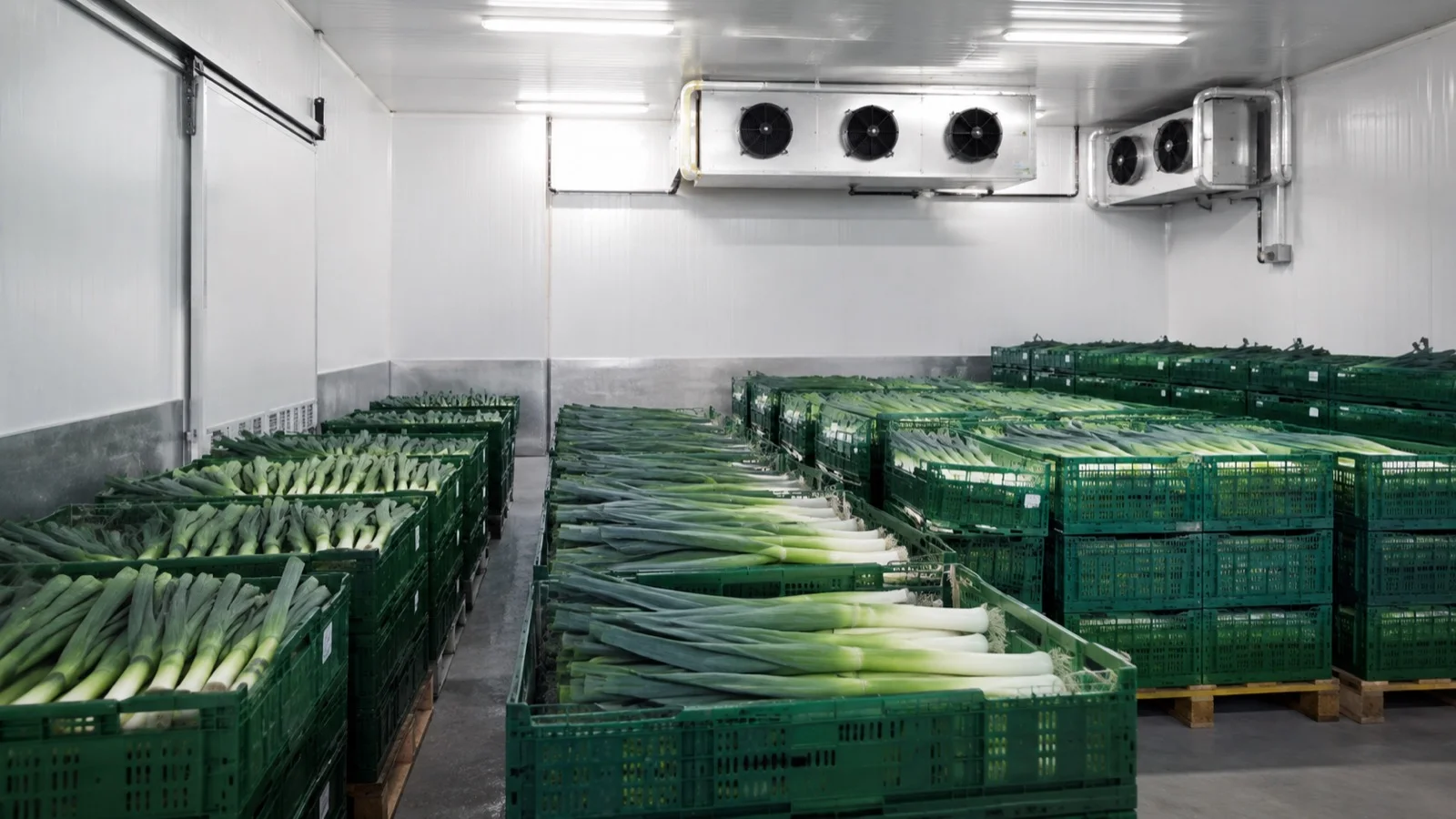
Design fresh-air intake at ~120 m³/ton (crop specific) — sufficient to remove respiration heat and CO₂.
4. Cooling (Optional)
Modular chillers or evaporators where ROI justifies the investment — especially for export-grade produce or longer storage periods.
Design principle: Uniform airflow is more effective than peak airflow.
Properly sized fans and ducts prevent hot spots and reduce decay.
Why Arch-Type Hangars Fit Africa, India, and Similar Markets
Affordability
Cooperatives, farmer groups, and small agribusinesses can finance a single hangar where framed construction would be unattainable.
Speed
Fast build times allow growers to protect crops within the same season.
Loss Reduction
Simply keeping produce dry, shaded, and well-ventilated can cut losses by 50%.
Scalability
Start with one hangar and add units as volumes grow.
Upgrades (better fans, ducts, cooling) can be installed in phases.
Simple ROI: Back-of-the-Envelope Economics
| Scenario | Without Hangar | With Arch Hangar | Impact |
|---|---|---|---|
| 1,000 t onions (India) | ~30% loss = 300 t | ~10–15% loss = 100–150 t | Save 150–200 t/season (≈ $30–40k @ $200/t) |
| CAPEX | — | $80k–$100k (typical) | Payback ~2–3 years |
Actual performance varies by crop, climate, local pricing, and operational discipline — but consistently demonstrates strong financial value.
Regional Highlights
Africa (East, West, South)
Priority: shade, rain protection, strong airflow.
Modular fans and floor ducts offer the biggest early improvements.
India
Massive onion and potato volumes benefit from distributed hangars that stabilize prices and reduce market volatility.
South & Southeast Asia / Latin America
Humidity control and drying capacity are essential.
Cooling can be added in stages as export programs grow.
Construction & Delivery Overview
Site Preparation
-
Compacted base
-
Drainage channels
-
Orientation aligned with prevailing winds
Structure
-
Prefabricated steel arches
-
Corrosion-resistant coatings
-
Simple anchoring systems
Installation
-
Local crew training (2–5 days)
-
Full assembly within weeks
-
Minimal heavy machinery required
Future Upgrades
-
Ventilation ducts
-
T/RH/CO₂ sensors
-
Dust filtration
-
Modular chillers
Critical Principle
A building cannot fix poor intake quality.
Always ensure proper curing/drying, remove field moisture and soil, and avoid loading diseased lots.
Good storage starts before the crop enters the hangar.



More articles
 Advanced Potato Storage Technology: Bulk Ventilation, Climate Control & Engineering Specs
Learn how modern bulk potato storage systems maintain optimal temperature, humidity, CO₂ levels, and airflow to protect crop quality. Full engineering parameters, ventilation design, cooling capacity, and monitoring solutions.
News
Advanced Potato Storage Technology: Bulk Ventilation, Climate Control & Engineering Specs
Learn how modern bulk potato storage systems maintain optimal temperature, humidity, CO₂ levels, and airflow to protect crop quality. Full engineering parameters, ventilation design, cooling capacity, and monitoring solutions.
News
 Agrovent opening a front office in the Republic of Kazakhstan
Explore new opportunities with our presence in Kokshetau, Kazakhstan.
News
Agrovent opening a front office in the Republic of Kazakhstan
Explore new opportunities with our presence in Kokshetau, Kazakhstan.
News
 Potato storage technology
Learn how bulk and container potato storage systems work, how to manage drying, healing, cooling, humidity and CO₂, and how to protect quality long-term
News
Potato storage technology
Learn how bulk and container potato storage systems work, how to manage drying, healing, cooling, humidity and CO₂, and how to protect quality long-term
News
 Agritechnica, we’re coming!
We announce participation in the exhibition Agritechnica-2019, Hannover, meet us!
News
Agritechnica, we’re coming!
We announce participation in the exhibition Agritechnica-2019, Hannover, meet us!
News
 Prolonging the life of seeds
These findings are particularly interesting for seed storage in tropical climates, where storage in a cool place is expensive.
News
Prolonging the life of seeds
These findings are particularly interesting for seed storage in tropical climates, where storage in a cool place is expensive.
News
 Underground Farms at Seoul Subway Stations
Discover how Seoul’s underground vertical farms use hydroponics, LED lighting and AI to grow vegetables in metro stations. Learn how these climate-resilient farming technologies support food security in India, Africa and Saudi Arabia.
Underground Farms at Seoul Subway Stations
Discover how Seoul’s underground vertical farms use hydroponics, LED lighting and AI to grow vegetables in metro stations. Learn how these climate-resilient farming technologies support food security in India, Africa and Saudi Arabia.

Leave your contacts and we will get back to you