Expert Talk: Microbial Preparations for Onion Storage in Maharashtra

Expert perspective: Alexander Samsonov, Agricultural Storage Engineer. View LinkedIn profile.
Editorial note: This article describes a pilot-testing concept, not a universal treatment prescription. Any microbial product, concentration or application method must be locally registered, tested against local isolates and validated with a qualified plant pathologist.

Black mold can cause material storage losses in warm, humid regions such as Maharashtra. Microbial protection is being studied as one possible part of an integrated storage programme, alongside curing, handling discipline and uniform ventilation. Here’s how biocontrol works in real storage systems.
Microbial Protection for Onions in Maharashtra: Why It Matters and How It Works
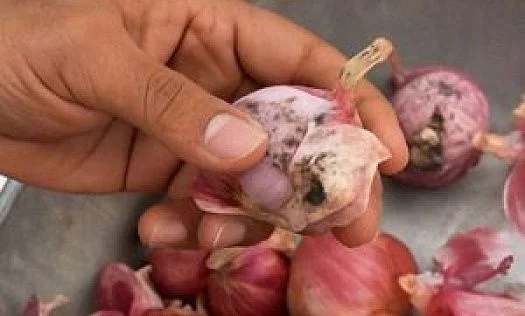
Warm, humid weather at harvest makes Maharashtra one of the world’s most challenging environments for onion storage. These conditions are ideal for Aspergillus niger, the black mold responsible for rapid rot, weight loss, and high post-harvest losses.
With chemical fungicides becoming less desirable or restricted, growers are turning toward microbial biocontrol - biological-control approaches that must be validated for the local pathogen population, onion variety and permitted products.
Why Onions in Maharashtra Need Microbial Protection
The combination of:
-
high temperature,
-
high humidity,
-
dense harvest season,
-
traditional open curing,
-
and warm-storage systems (27–31 °C)
creates perfect conditions for A. niger to colonize bulbs.
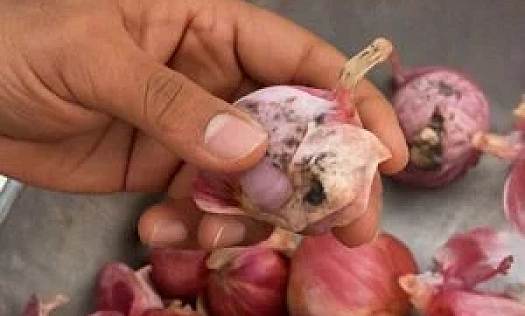
Black mold can develop on the outer scales and enter through damaged or poorly cured tissue. Moisture, condensation, handling damage and uneven drying all increase the risk.
Biological-control candidates may compete with the pathogen or influence the bulb surface, but their effect must be demonstrated under local conditions.
Which Microorganisms Can Be Screened?
Depending on local registration and laboratory advice, a research programme may screen candidates from groups such as Bacillus species, Trichoderma species, Aureobasidium pullulans, antagonistic yeasts and Clonostachys rosea. Inclusion on this list does not establish efficacy for a particular onion variety, pathogen isolate or commercial product.
How Application Methods Should Be Developed
There is no universal concentration or application recipe for every commercial product. A qualified plant pathologist should select locally permitted candidates, test them against local A. niger isolates, confirm compatibility with the onion variety and determine whether spray, dip or another application route is appropriate. Treated onions must still enter storage properly cured and dry.
What Does a Pilot Project Look Like?
A typical field trial includes:
-
Selecting 2–3 candidates (e.g., Bacillus, Trichoderma, a yeast).
-
Running lab tests against local A. niger isolates.
-
Small-scale trials with 1,000–2,000 bulbs.
-
Comparing treated vs. untreated onions for 30–60 days.
-
Measuring:
-
visible mold,
-
weight loss,
-
rot progression,
-
sprouting behavior.
-
This approach identifies the best strain for local climate and bulb type.
How Results Should Be Evaluated
Compare treated and untreated lots under the same curing, airflow and climate conditions. Track visible mold, total weight loss, rot, sprouting and marketable yield over a defined period. A pilot is successful only when the measured improvement is repeatable and economically relevant.
Microbial protection cannot compensate for wet, immature or badly damaged onions, or for a storage room with uncontrolled condensation and poor airflow.
Want to Improve Onion Storage in Warm Climates?
Agrovent designs warm-storage systems and climate-controlled chambers for India, the Middle East, Africa, and South America.
We help clients integrate:
-
curing solutions,
-
optimized airflow design,
-
CO₂ and temperature monitoring,
-
microbial protection workflows,
-
and warm-storage engineering (27–31 °C).
Discuss an onion storage project with Agrovent India on WhatsApp.
Related Agrovent Reading
- Onion Storage Systems for Hot and Humid Climates
- Should India Change Its Onion Storage Culture?
- Microbial Protection for Onions in Maharashtra
Sources and Further Reading



More articles
 From Orchard to Bottle: How Apple Growers Can Profit from the Global Cider Boom
It’s apple season - and the question for many growers is what to do with all that abundance. One answer: cider. Around the world, cider is transforming from a niche beverage into a global trend. Here’s how apple farmers can tap into this growing market - and how Agrovent supports them from storage to production.
News
From Orchard to Bottle: How Apple Growers Can Profit from the Global Cider Boom
It’s apple season - and the question for many growers is what to do with all that abundance. One answer: cider. Around the world, cider is transforming from a niche beverage into a global trend. Here’s how apple farmers can tap into this growing market - and how Agrovent supports them from storage to production.
News
 Agrovoltaics: The Future of Farming Powered by the Sun
Learn how solar energy and agriculture are merging through agrovoltaic technology. Discover the Insolight “Insolagrin” project - a groundbreaking solar farm that could transform global food and energy production.
News
Agrovoltaics: The Future of Farming Powered by the Sun
Learn how solar energy and agriculture are merging through agrovoltaic technology. Discover the Insolight “Insolagrin” project - a groundbreaking solar farm that could transform global food and energy production.
News
 Post-harvest processing and cooling of berries
How to extend the shelf life of a berry crop?
Harvest
Post-harvest processing and cooling of berries
How to extend the shelf life of a berry crop?
Harvest
 Black Mold in Onion Storage: Aspergillus niger Risks and Handling
Black mold in stored onions is commonly associated with Aspergillus niger. Learn how moisture, condensation and handling damage increase risk, and what storage managers should check before deciding how to handle an affected lot.
Harvest
Black Mold in Onion Storage: Aspergillus niger Risks and Handling
Black mold in stored onions is commonly associated with Aspergillus niger. Learn how moisture, condensation and handling damage increase risk, and what storage managers should check before deciding how to handle an affected lot.
Harvest
 Detecting Onion Storage Hot Spots: Temperature, Humidity, VOCs and Inspection
How temperature and humidity trends, odour and VOC sensors, airflow checks and visual inspection can help detect onion spoilage zones before losses spread.
News
Detecting Onion Storage Hot Spots: Temperature, Humidity, VOCs and Inspection
How temperature and humidity trends, odour and VOC sensors, airflow checks and visual inspection can help detect onion spoilage zones before losses spread.
News
 Alex Samsonov interview
Alex Samsonov, a seasoned expert in vegetable and potato storage, shares insights from his years of experience designing and implementing innovative solutions. With a global perspective and a focus on both technical efficiency and economic viability, Alex offers practical advice for addressing the challenges of modern storage practices.
Alex Samsonov interview
Alex Samsonov, a seasoned expert in vegetable and potato storage, shares insights from his years of experience designing and implementing innovative solutions. With a global perspective and a focus on both technical efficiency and economic viability, Alex offers practical advice for addressing the challenges of modern storage practices.

Leave your contacts and we will get back to you