


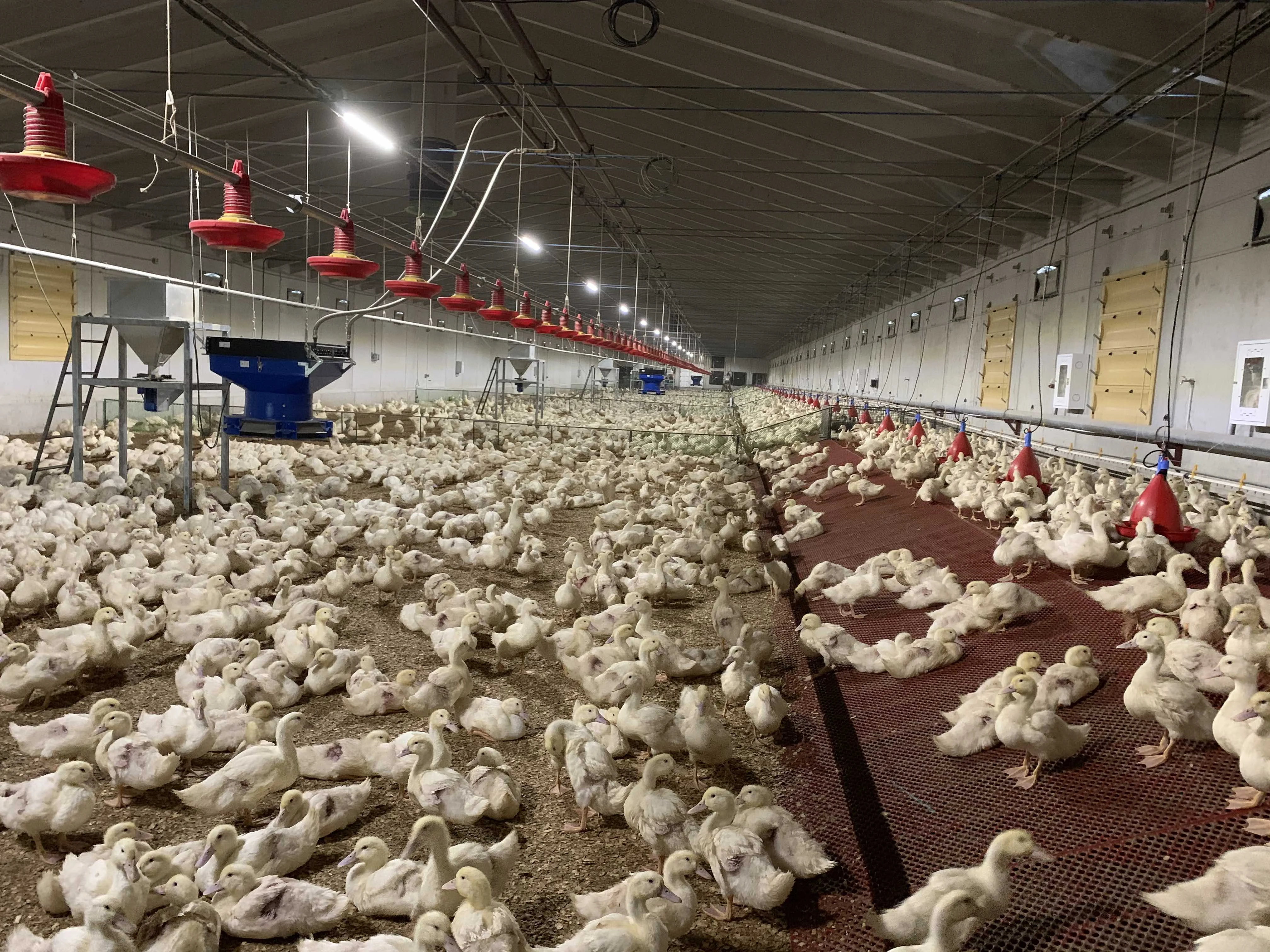
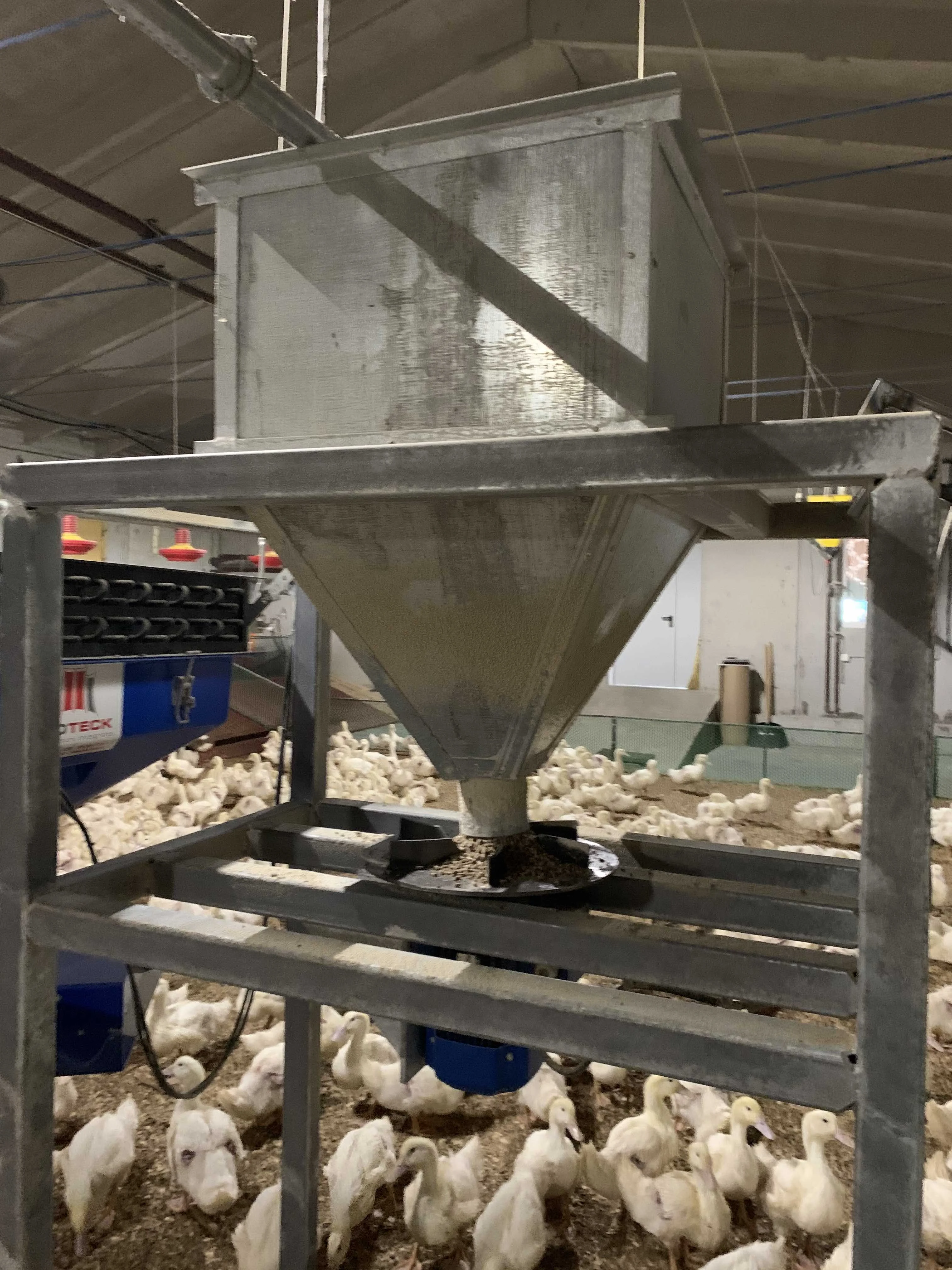
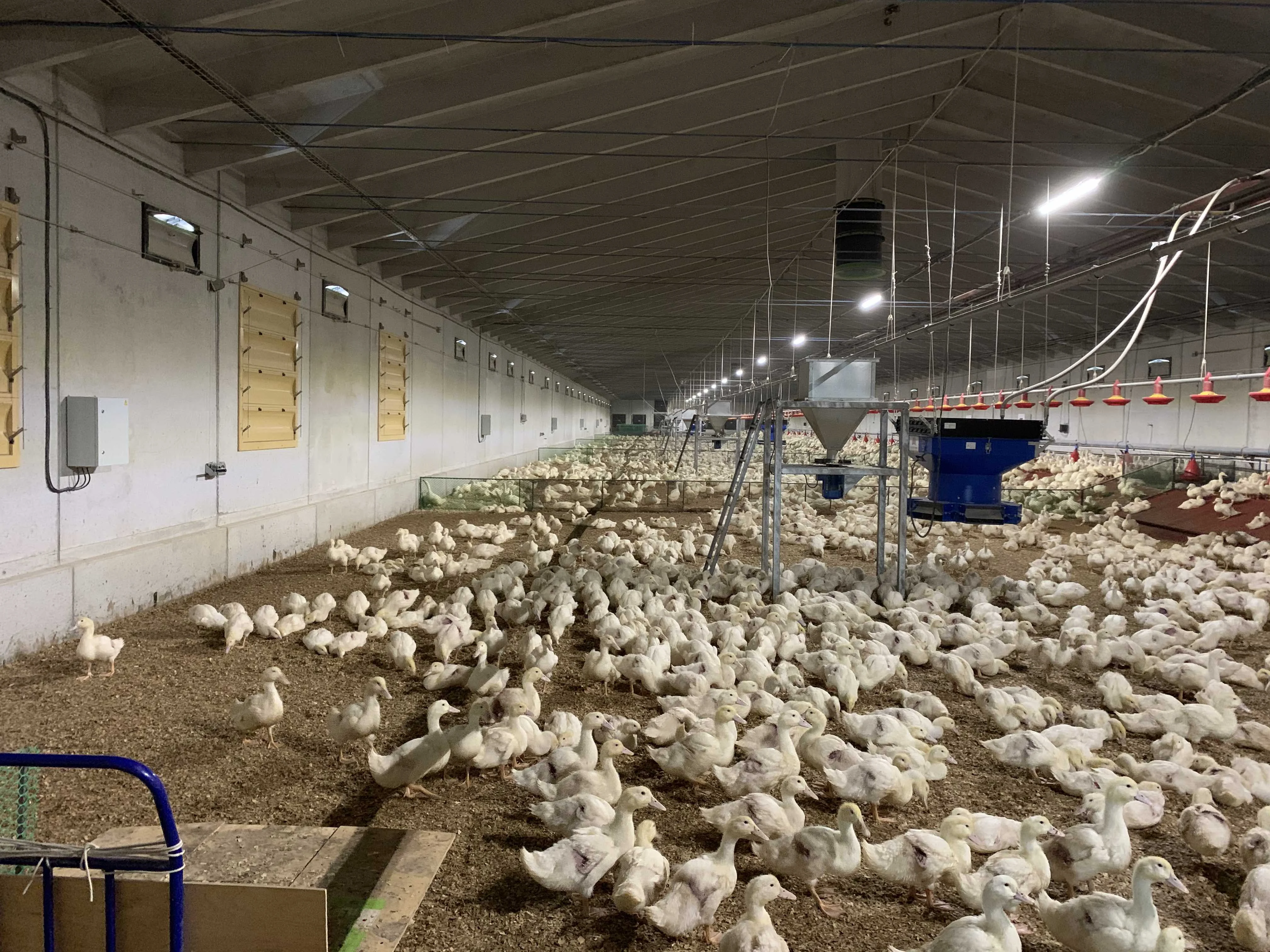
The "CruTik" Spinfeeder is an automatic floor feeding system designed for poultry houses. It spreads feed in a wide circular pattern so that every bird can reach it at the same time. This reduces crowding and stress during feeding and helps the flock grow more evenly, reaching peak productivity together. The unit can be installed either on the floor with its own frame or suspended from the ceiling. Feed is delivered into the hopper from above through a screw conveyor.
How it worksFeed pellets are transported from a silo or storage bin into the top hopper using a flexible screw conveyor. Distribution can be set by weight or time. The feed then drops onto a spinning plate powered by an electric motor, which throws it evenly across the floor using centrifugal force. The spreading diameter can be adjusted. After each cycle, the hopper refills automatically for the next feeding. The design allows for pressure washing, and all moving parts are safely enclosed.
In broiler breeder flocks, the role of males is just as vital as that of the hens. Hens produce the eggs, but it’s the roosters that fertilize them, making it possible to generate market-ready chicks. Simply producing eggs is not the goal — what ultimately matters is the number of healthy chicks hatched. Managing, caring for, and handling roosters is always more demanding and requires closer attention compared to the females.
Mike Ilitsa– Veterinarian
'From my own practice, I’d like to highlight the feeding of breeder roosters with the Spin Feeder. Their productivity is just as essential as that of the hens, since eggs without fertilization are useless for commercial chick production.
“While hens lay the eggs, it is the roosters that fertilize them and make chick production possible.”
Whenever possible, young roosters should be housed separately from females, either in dedicated pens or coops, and should not be raised together. This separation is important because stocking density, feed requirements, and feeding areas for males are always different from those of hens.
For the first 5–6 days of life, male chicks should be placed in brooding pens at a density of 35–40 per square meter, with each pen designed to hold 500–1,000 chicks. Proper heating and adequate lighting are crucial. In the beginning, provide one feeder for every 35–50 chicks and one drinker for every 50–70 chicks. At least 55–60% of the floor should be covered with chick paper for feeding. The paper should remain in place for the first three days and be removed on day four. Drinker numbers should be gradually cut in half starting at the end of the third day and eliminated completely by the fourth day.
During the first week, young roosters are usually fed without restriction. Their body weight is checked at the end of day seven. In many cases, it’s recommended to give them a higher-energy starter feed (closer to broiler starter specifications rather than breeder starter) for the first one to two weeks. Beginning on day six, pens should be enlarged so that stocking density is about 20 chicks per square meter, and the number of feeders should be increased so there is one for every 25 chicks.
If males have already reached or exceeded their target weight by day seven, controlled daily feeding should begin. The ration must be measured and evenly divided among the feeders in the morning. If the weight target hasn’t been achieved, free-choice feeding continues up to day fourteen, with body weights checked every 2–3 days. Once the goal is reached, restricted feeding can start. In some flocks, roosters may not hit the target until the third week, which can signal an issue with feed quality or lack of uniformity in the flock.
Switching to the spin feeder should not be rushed. The main focus for the first two weeks is to get males to the right weight and body condition. If the weight target is met by day fourteen, a gradual six-day transition program to the spin feeder can begin:
-
Day 15 – 70% of the ration in chick feeders, 30% scattered manually. (Same feeder count as before)
-
Day 16 – Split 50/50 between chick feeders and hand feeding. Reduce feeders by about 30%. Spin feeders are run empty.
-
Day 17 – 70% of the feed in chick feeders, 30% in the spin feeder. Feeder numbers remain at the day-16 level.
-
Day 18 – Half the ration in chick feeders, half in the spin feeder. Reduce feeder count by another 20%.
-
Day 19 – 30% in chick feeders, 70% in the spin feeder. Reduce feeders by 20% compared to the previous day.
-
Day 20 – 100% of the feed in the spin feeder. Chick feeders are removed before feeding.
This changeover can be stretched by an extra day or two if needed. Each day, crops of at least 100 roosters per pen should be checked after feeding to ensure the transition is working and that feed distribution is uniform. Later on, feeding zones must be calculated according to the number of roosters in the pen and checked visually during feeding. Unlike hens, roosters tend to prefer a bit more space and less crowding while eating. For this reason, the feeding intervals, machine speed, and throwing distance need to be carefully planned, monitored, and adjusted week by week.
Ideally, rooster grading should be carried out by the end of the first week. Sorting males early is key for narrowing the gap between the smallest and the largest birds. This step helps prevent losses linked to body weight or bone development issues, while also promoting consistency in growth by keeping weights under control.
By the 3rd and 4th weeks, housing density should be adjusted to about 12 birds per square meter, or existing pens should be reorganized to match this standard.
After the second grading in week 5, it becomes necessary to move over to the AÇ-TOK feeding method. From this stage, density drops to 9 males per square meter, which means each spin feeder will be serving fewer birds. That reduction causes less feed per machine during daily distribution, which can shorten feeding sessions, create uneven access, and hurt flock uniformity.
To solve this, alternative feeding schedules are used starting in week 5, such as 6-1 (feed six days, fast one day — weekly ration divided as daily feed × 7 ÷ 6) or 5-2 (feed for three days, fast one, feed for two, fast one — weekly ration spread as daily feed × 7 ÷ 5). The 5-2 program, in particular, concentrates the weekly feed into just five days instead of seven, which increases the amount available per spin feeder cycle. This ensures feeding sessions last longer, feed is spread more evenly, and the roosters consume it in a more uniform way.
Take this example: in a pen of 2,200 roosters at 10 weeks of age, each bird’s weekly allowance is 70 g. If feeding were done every day, the total would be 2,200 × 0.070 = 157 kg of feed daily. The spin feeder would release this amount in about 3 minutes, and the birds would finish eating in 15–20 minutes. In such a setup, the more active or hungrier roosters would inevitably eat more than others, causing variation within the flock.
Now, if the 5-2 program is applied, the math changes. Instead of 70 g per day, the ration becomes 70 × 7 ÷ 5 = 98 g, meaning 2,200 × 0.098 = 216 kg on feeding days. Dispensing this larger amount would take 4–4.5 minutes. Because of the fasting days, the flock’s appetite is more balanced, and the higher feed quantity combined with stronger motivation to eat results in a more even distribution of feed intake. This directly improves uniformity across the flock. The effectiveness of this approach should always be confirmed by crop checks after feeding.
As the birds grow, the feeding program must evolve. When the daily feed per rooster climbs to roughly 115 g, the 5-2 system should shift over to a 6-1 system. Once that reaches around 120 g per day, it’s time to transition back to daily feeding. This avoids excessive crop enlargement or overcrowding at the feeder, both of which could cause losses. Every transition should be validated with crop scoring to ensure the birds are eating evenly. Table 1 outlines these stages in relation to daily feed amounts.
During the first few days (around 3–4) of moving roosters onto spin feeder feeding, it’s useful to raise the light level at morning feeding so the birds can clearly see the feed. If the lighting is already above 10 lux, visibility is sufficient. Once the flock has adapted to the feeders, this extra light should no longer be used.
When the spin feeders first start up in the morning and release a large amount of feed, roosters may overreact — running, flying toward the feeders, or even colliding with drinkers and with each other, which can result in injuries. To prevent this, it’s better to switch the lights off just before the machines start. The house should remain dark until about one-third of the ration has been distributed, then the lights can be turned back on. This method calms the birds’ response to the sudden feed drop and avoids unnecessary stress or trauma.
A widely used routine is: first turn the lights on, allow roosters 15–20 minutes to drink water and soften their crops, then turn the lights off, distribute the feed, and finally turn the lights back on. Introducing this habit early helps improve both motivation and adaptation to the feeding system.
Some farms try to increase light intensity during feeding, making the house brighter. However, this approach can backfire, since higher light levels at feeding can trigger unwanted behaviors such as aggression or even cannibalism. Because birds develop long-term habits from the way they are managed at the start, it is best to stick with the calmer, more controlled method described above.
Discuss the equipment and installation requirements with Agrovent.
Discuss your project
