

The Role of the Condenser in Cold Storage Facilities
The condenser is a key component of a refrigeration system and performs several critical functions:
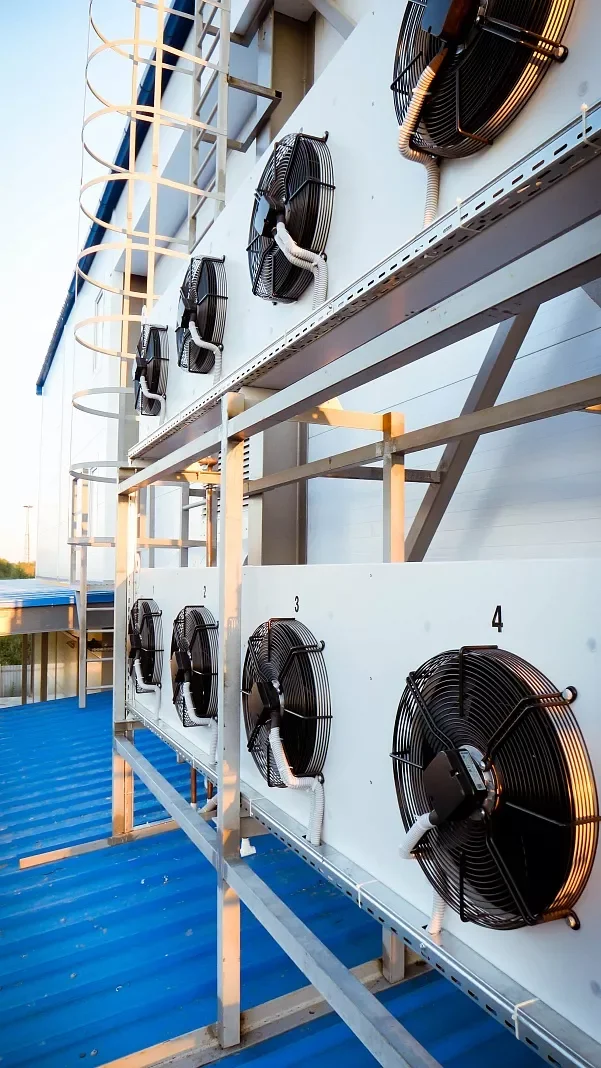
Main Functions
- Heat removal from the refrigerant
- The condenser transforms the hot, gaseous refrigerant discharged from the compressor into liquid form by releasing heat to the surrounding medium (air or water).
- This ensures a closed refrigeration cycle and maintains the required storage chamber temperature.
- Stabilizing system operation
- Efficient heat exchange in the condenser reduces compressor load, extends equipment lifespan, and improves energy efficiency.
- Supporting uniform product cooling
- The condenser does not directly contact the produce but ensures stable air cooler operation, which is critical for even cooling of vegetables and fruits.
- Impact on humidity control
- Proper condenser temperature and pressure indirectly affect evaporator and air cooler performance, influencing humidity levels and preventing product dehydration.
Key Technical Parameters
For cold storage facilities, condenser parameters are selected based on product volume, target storage temperature, and refrigerant type:
- Condenser type
- Air-cooled (with fans): simple installation, suitable for small and medium facilities.
- Water-cooled: high heat transfer, effective for large installations or hot climates.
- Cooling capacity (Q)
- Must match the refrigeration load of the facility: typically 80–350 kW per 1,000 tons of produce, similar to air coolers.
- Operating pressure and temperature
- Maximum working pressure is selected according to refrigerant type (e.g., R-134a, R-404A).
- Condensing temperature is typically 5–10 °C above ambient temperature for air-cooled condensers.
- Air or water flow through the heat exchanger
- For air-cooled systems: 30–250 m³/h per ton of produce to ensure efficient heat removal and stable operation.
- Heat exchanger design
- Copper/aluminum finned tubes with an optimal fin spacing of ≥ 7 mm to reduce fouling and corrosion.
- Control systems
- Automatic regulation by temperature, pressure, and weather conditions.
- Support for recirculation and fan control to ensure even heat dissipation.
Overall, the condenser ensures reliable heat rejection, system stability, and consistent operating conditions, making it an essential part of cold storage refrigeration systems.
Discuss the equipment and installation requirements with Agrovent.
Discuss your project
